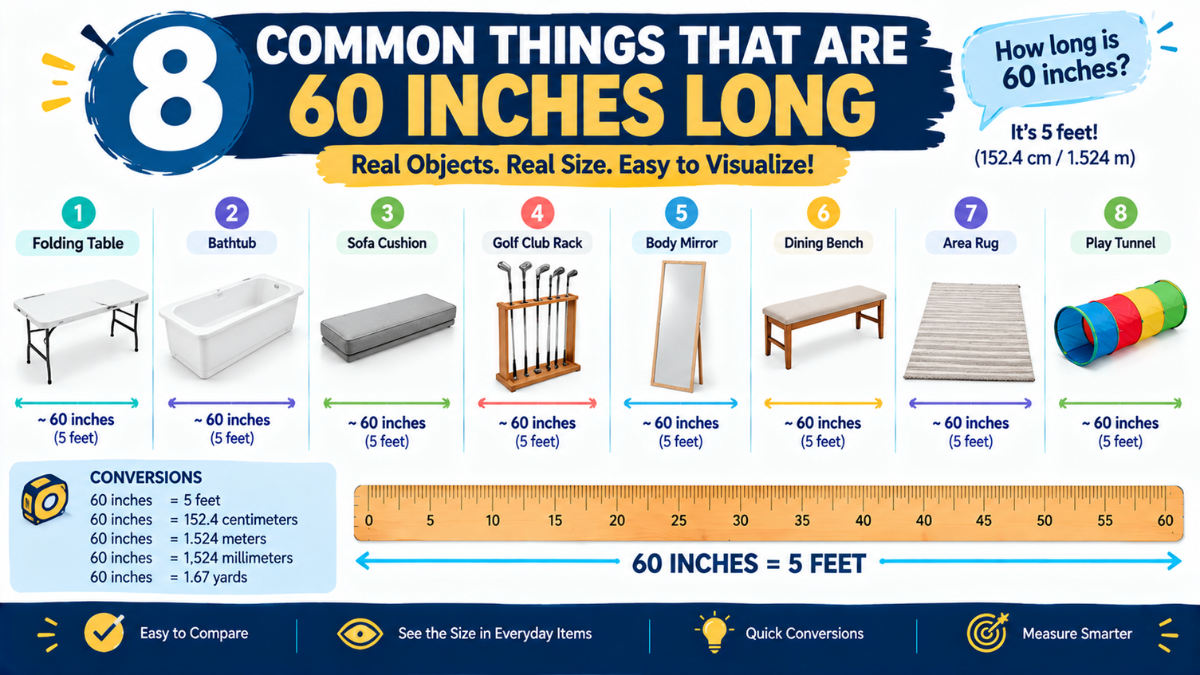
If you are asking how long is 60 inches, the simplest answer is 5 feet. That makes this measurement fairly easy to relate to everyday objects.
Sixty inches is also 152.4 centimeters or 1.524 meters. It is a little longer than 1.5 meters.
Several familiar objects can come close to this length. Furniture, sports equipment, household items, and storage products often fall within this range.
In this article, we will look at 8 common things that are around 60 inches long. The examples are useful for getting a practical sense of the measurement without relying on the number alone, if you are measuring smaller hardware or precise dimensions, start with our guides on 5 inches and 6 inches.
Quick Answer: How Long Is 60 Inches?
60 inches equals exactly 5 feet.
Here are the main conversions:
- 60 inches = 5 feet
- 60 inches = 152.4 centimeters
- 60 inches = 1.524 meters
- 60 inches = 1,524 millimeters
- 60 inches ≈ 1.67 yards
- 60 inches = 5 feet exactly
- 60 inches is 12 inches longer than 48 inches
- 60 inches is 10 inches longer than 50 inches
- 60 inches is 10 inches shorter than 70 inches
- 60 inches is 20 inches longer than 40 inches
The easiest value to remember is 5 feet.
8 Common Things That Are Around 60 Inches Long
Here are eight familiar examples that can be close to this length:
- A five-foot folding table
- A standard bathtub
- A large sofa cushion
- A golf club storage rack
- A full-length body mirror
- A small dining bench
- A large area rug
- A children’s play tunnel
Exact sizes can vary. Some products may be several inches shorter or longer than the reference measurement.
1. A Five-Foot Folding Table 🪑
A folding table measuring sixty inches is exactly five feet long.
These tables are useful at parties, family gatherings, markets, classrooms, and outdoor events.

Why it is a useful comparison
The tabletop provides a straight, easy-to-measure surface.
Place a tape measure along its longest edge. A 60-inch table will cover exactly five feet.
Folding tables come in several sizes
Common folding tables can measure 4, 5, 6, or 8 feet.
A five-foot model sits between the smaller four-foot tables and larger six-foot versions.
The width can also differ, so length should be checked separately when planning a space.
2. A Standard Bathtub 🛁
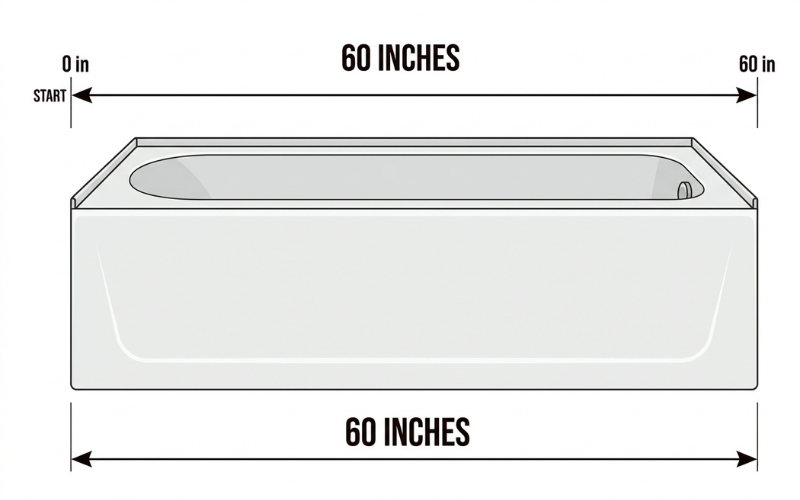
Many standard residential bathtubs are approximately 60 inches long.
This is one of the most useful household comparisons because a bathtub takes up a substantial amount of space.
Why bathtubs are often this size
A five-foot tub can fit into many standard bathroom layouts.
The actual exterior dimensions may differ slightly from the interior bathing area.
For installation, both length and width are important.
Tub sizes are not all identical
Some tubs are shorter.
Others are designed for larger bathrooms and can be significantly longer.
Always check the manufacturer’s dimensions when replacing or installing a bathtub.
3. A Large Sofa Cushion 🛋️
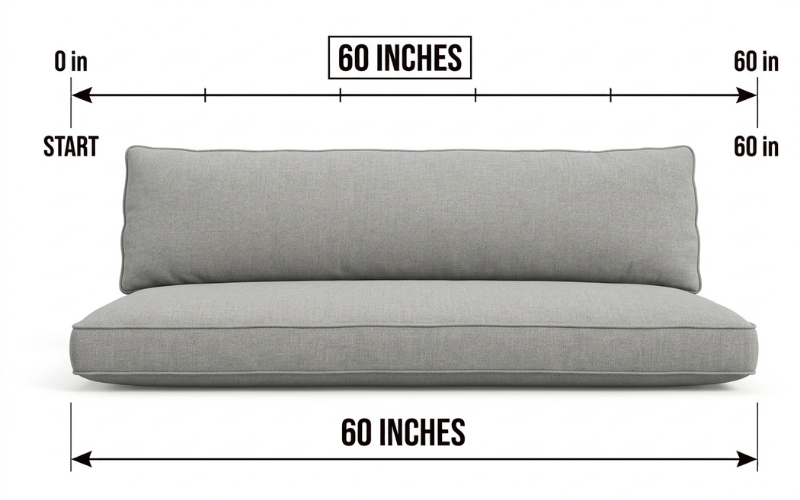
A long sofa cushion or bench-style cushion can measure close to sixty inches.
This is especially common with larger sofas, window seats, and custom seating.
How it compares
A cushion that stretches across five feet gives you a convenient household reference.
It is also easy to compare with a wall, table, or other nearby furniture.
Cushion dimensions vary
Some cushions are designed for individual seats.
Others run across an entire sofa.
The listed length may also exclude seams, piping, or small design features.
4. A Golf Club Storage Rack ⛳
Some golf club racks and organizers can be around five feet long.
Long storage units are useful in garages, clubhouses, sports shops, and golf facilities.
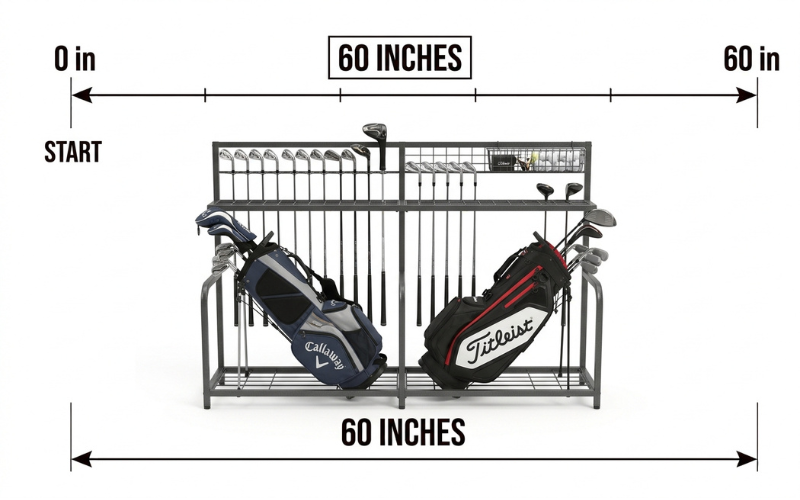
Why this works as a comparison
A rack measuring sixty inches would stretch across the same five-foot distance as the measurement in question.
Its long horizontal shape makes the comparison straightforward.
Storage racks come in different designs
A compact rack may be much shorter.
Larger commercial units can extend well beyond five feet.
The number of clubs or equipment pieces it holds can affect its dimensions.
5. A Full-Length Body Mirror 🪞
Large floor-standing mirrors can reach heights close to sixty inches.
Some models are taller, while others are shorter.
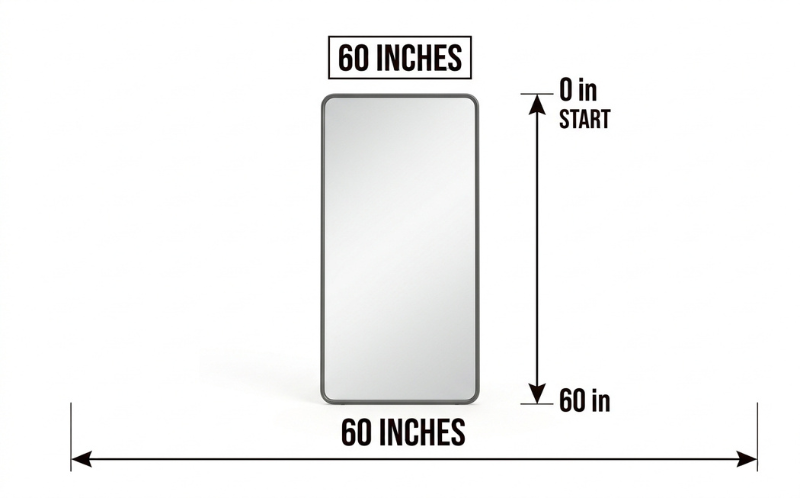
Why a mirror provides a helpful reference
A mirror around five feet tall gives you a familiar vertical comparison.
For many people, it is around chest-to-head height or higher, depending on the person’s height and the mirror’s placement.
Mirror size depends on its design
A decorative frame can add several inches to the overall height.
The glass itself may therefore be smaller than the advertised exterior dimensions.
Always check whether the listed measurement refers to the glass or the complete mirror.
6. A Small Dining Bench 🪑
A compact dining bench can measure close to sixty inches in length.
This size allows several people to sit along one side of a dining table.
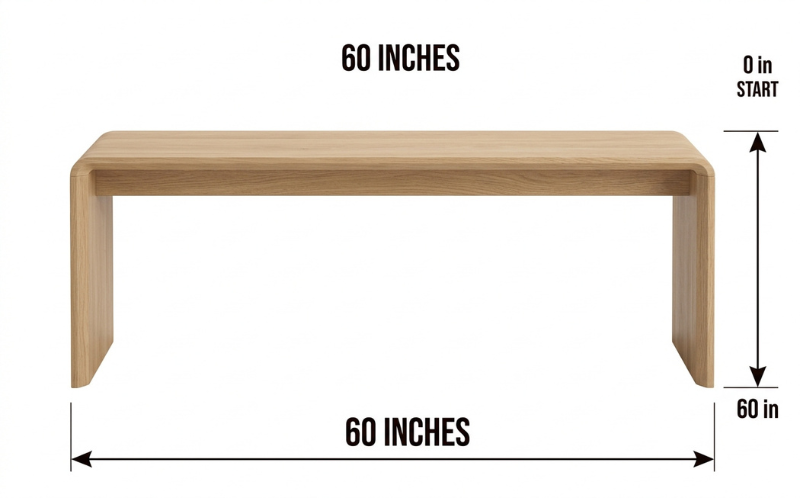
Why a bench is a good reference
Unlike a chair, a bench has one continuous length.
A five-foot bench therefore gives you a clear idea of the distance.
Bench sizes vary
Some benches are designed for two people.
Others are made for three or more.
Seat depth and height are also important measurements, especially when matching a bench with a table.
7. A Large Area Rug 🏠
Some area rugs have one side measuring approximately sixty inches.
For example, a rug may be 5 feet wide while being considerably longer in the other direction.
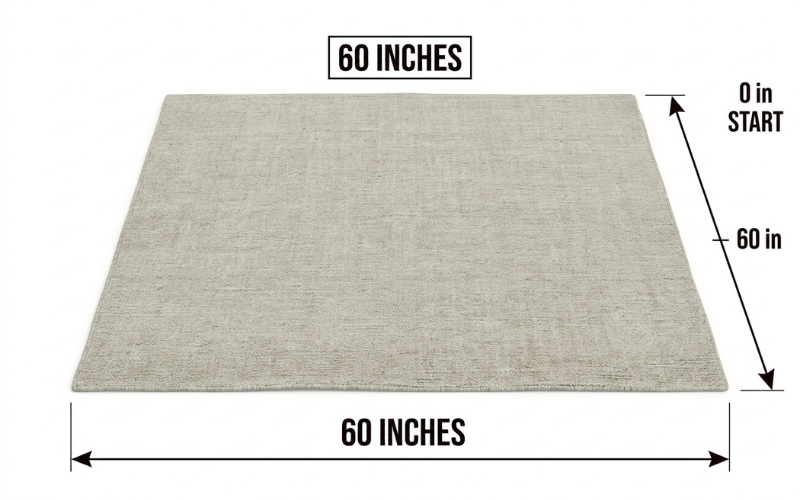
Why this comparison works
A rug is laid flat across a floor.
That makes its dimensions easy to measure from one edge to another.
A 5-foot-wide rug covers a substantial section of a room without taking up the entire floor.
Rug sizes are usually given as length × width
A rug described as 5 × 7 feet has one side measuring 60 inches.
The other side measures 84 inches.
This is important because the 60-inch dimension applies to only one side.
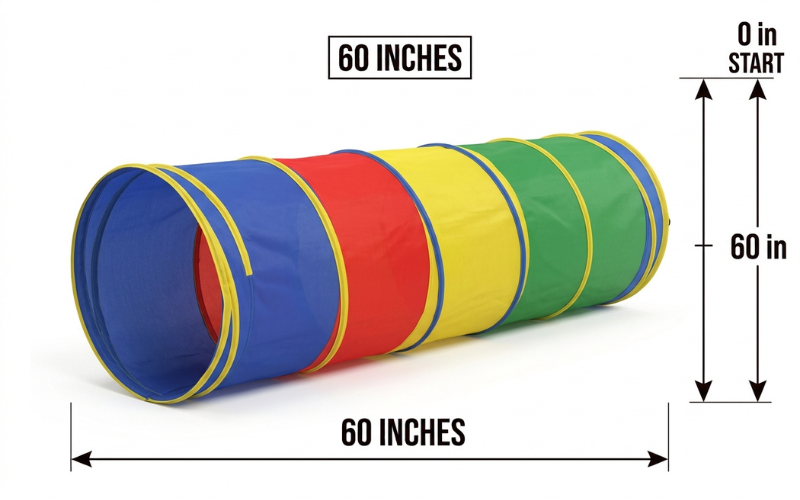
8. A Children’s Play Tunnel 🧸
Some indoor and outdoor children’s play tunnels can approach five feet in length.
These tunnels are designed for crawling, play areas, classrooms, and backyard activities.
Why it makes a good comparison
The tunnel creates a clear start and finish.
A child would crawl through a tunnel around five feet long to travel from one end to the other.
Play tunnels come in many lengths
Small tunnels may be only a few feet long.
Longer models can extend well beyond sixty inches.
Some are also expandable, so their final length depends on how they are arranged.
How Long Is 60 Inches in Feet?
There are 12 inches in one foot.
Therefore:
60 ÷ 12 = 5 feet
So:
60 inches = 5 feet
This is one of the easiest inch-to-foot conversions to remember because 60 divides evenly by 12.
How Long Is 60 Inches in Centimeters?
One inch equals 2.54 centimeters.
Therefore:
60 × 2.54 = 152.4 centimeters
So:
60 inches = 152.4 cm
That is slightly more than 1.5 meters.
How Long Is 60 Inches in Meters?
Since 100 centimeters equal one meter:
152.4 ÷ 100 = 1.524 meters
Therefore:
60 inches = 1.524 meters
For a quick estimate, you can round it to about 1.52 meters.
How Long Is 60 Inches in Millimeters?
One centimeter contains 10 millimeters.
Since the length is 152.4 centimeters:
152.4 × 10 = 1,524 millimeters
Therefore:
60 inches = 1,524 mm
How Long Is 60 Inches in Yards?
One yard contains 36 inches.
So:
60 ÷ 36 ≈ 1.67 yards
Therefore:
60 inches ≈ 1.67 yards
That is one yard plus another 24 inches.
Is 60 Inches Exactly 5 Feet?
Yes.
This is an exact conversion.
Since one foot contains 12 inches:
12 × 5 = 60 inches
Therefore, 60 inches is exactly 5 feet.
Is 60 Inches Longer Than 4 Feet?
Yes.
Four feet equals 48 inches.
The difference is:
60 − 48 = 12 inches
So the measurement is exactly one foot longer than four feet.
Is 60 Inches Longer Than 50 Inches?
Yes.
The difference is:
60 − 50 = 10 inches
That means a 60-inch object is 10 inches longer than a 50-inch object.
In centimeters, the difference is 25.4 cm.
Is 60 Inches Shorter Than 6 Feet?
Yes.
Six feet equals 72 inches.
The difference is:
72 − 60 = 12 inches
So 60 inches is exactly one foot shorter than six feet.
How Long Is 60 Inches Compared With 40 Inches?
Forty inches equals 3 feet 4 inches.
The difference is:
60 − 40 = 20 inches
So the longer measurement extends another 20 inches.
That is 1 foot 8 inches more.
How Long Is 60 Inches Compared With 36 Inches?
Thirty-six inches equals exactly three feet.
The difference is:
60 − 36 = 24 inches
Therefore, the target length is two feet longer than 36 inches.
How Long Is 60 Inches Compared With 24 Inches?
Twenty-four inches equals two feet.
The difference is:
60 − 24 = 36 inches
So 60 inches is exactly three feet longer than 24 inches.
It is also 2.5 times as long as 24 inches.
How Long Is 60 Inches Compared With 72 Inches?
Seventy-two inches equals six feet.
The difference is:
72 − 60 = 12 inches
So the measurement is exactly one foot shorter than six feet.
Can You Measure 60 Inches Without a Tape Measure? 📏
You can estimate the distance by using known objects or smaller measurements.
For exact work, a tape measure or ruler is still the better option.
Use Five One-Foot Sections
One foot equals 12 inches.
Five feet therefore gives:
12 + 12 + 12 + 12 + 12 = 60 inches
This is a simple way to recreate the measurement.
Use a Four-Foot Object
A four-foot object measures 48 inches.
Add another 12 inches.
You now have exactly 60 inches.
Use Centimeters
If you prefer metric measurements, remember:
60 inches = 152.4 cm
That is about 1.52 meters.
The Easiest Way to Remember This Length 🧠
The simplest reference is:
60 inches = 5 feet
You can also remember:
60 inches = 152.4 centimeters
and
60 inches = 1.524 meters
For everyday use, five feet is the easiest value.
Why Familiar Objects Make Lengths Easier to Relate To
Numbers can be difficult to compare without a reference.
Everyday objects give the measurement a practical context.
A bathtub, folding table, bench, or rug can help you estimate whether a space is close to five feet.
These comparisons can be useful when:
- Measuring furniture
- Planning a bathroom
- Checking available floor space
- Buying storage equipment
- Choosing a rug
- Planning a dining area
- Comparing household products
- Estimating room dimensions
For anything that needs to fit precisely, use the actual listed dimensions.
A Simple Measurement Challenge 🎯
Choose a nearby object that you think might be about five feet long.
A table, bench, shelf, or piece of furniture can work well.
Estimate its length first.
Then measure it with a tape measure.
You may find that your estimate is closer than expected, or you may discover that the object is several inches shorter or longer.
Why Common Objects May Not Be Exactly 60 Inches
The examples in this article are intended as approximate comparisons.
Manufacturers use different dimensions for similar products.
A bathtub, bench, table, or rug may therefore vary from one model to another.
Product dimensions depend on design
Size can change because of:
- Manufacturer
- Model
- Intended use
- Materials
- Construction
- Available space
- Adjustable features
For example, one folding table may be 60 inches long, while another model could be 48 or 72 inches.
Always check the listed dimensions
If you are buying an item for a specific space, do not rely on a general size comparison.
Check the product specifications.
Measure the available area as well.
Where You Might Encounter a 60-Inch Measurement
Furniture 🪑
Five-foot tables, benches, shelves, and seating pieces can fall around this length.
Bathroom Fixtures 🛁
Many standard residential bathtubs have an overall length close to five feet.
Home Décor 🏠
Large rugs and full-length mirrors can have a dimension around 60 inches.
Sports Equipment ⛳
Some golf storage racks and other sporting organizers can reach this size.
Children’s Equipment 🧸
Play tunnels and similar recreational products can be built around five feet long.
60 Inches in Different Units
| Unit | Equivalent |
| Inches | 60 in |
| Feet | 5 ft |
| Centimeters | 152.4 cm |
| Millimeters | 1,524 mm |
| Meters | 1.524 m |
| Yards | 1.67 yd |
| Difference from 48 inches | 12 inches |
| Difference from 50 inches | 10 inches |
| Difference from 40 inches | 20 inches |
| Difference from 36 inches | 24 inches |
| Difference from 72 inches | 12 inches |
60-Inch Comparison Chart
| Measurement | Difference from 60 inches |
| 12 inches | 48 inches shorter |
| 18 inches | 42 inches shorter |
| 24 inches | 36 inches shorter |
| 30 inches | 30 inches shorter |
| 36 inches | 24 inches shorter |
| 40 inches | 20 inches shorter |
| 42 inches | 18 inches shorter |
| 48 inches | 12 inches shorter |
| 50 inches | 10 inches shorter |
| 54 inches | 6 inches shorter |
| 58 inches | 2 inches shorter |
| 60 inches | Reference length |
| 62 inches | 2 inches longer |
| 64 inches | 4 inches longer |
| 66 inches | 6 inches longer |
| 72 inches | 12 inches longer |
| 84 inches | 24 inches longer |
Biowiki Table: 60-Inch Measurement at a Glance
| Measurement | Equivalent |
| Length | 60 inches |
| Feet | 5 feet |
| Centimeters | 152.4 cm |
| Millimeters | 1,524 mm |
| Meters | 1.524 m |
| Yards | 1.67 yd |
| Exact feet conversion | 5 ft |
| Difference from 4 feet | 1 ft |
| Difference from 5 feet | 0 |
| Difference from 6 feet | 1 ft |
| Difference from 50 inches | 10 in |
| Difference from 40 inches | 20 in |
| Difference from 36 inches | 24 in |
| Difference from 24 inches | 36 in |
| Half of the length | 30 in |
| Double the length | 120 in |
Frequently Asked Questions
How long is 60 inches?
60 inches equals 5 feet, 152.4 centimeters, or 1.524 meters.
What common things are around 60 inches long?
Examples include five-foot folding tables, many standard bathtubs, long sofa cushions, some golf storage racks, full-length mirrors, dining benches, large rugs, and children’s play tunnels.
Is 60 inches exactly 5 feet?
Yes. There are 12 inches in one foot, so 60 inches equals exactly five feet.
How many centimeters are in 60 inches?
There are exactly 152.4 centimeters.
How many meters are in 60 inches?
60 inches equals 1.524 meters.
Final Thoughts
Knowing how long is 60 inches is simple once you connect the number with a familiar reference.
The easiest comparison is five feet. A five-foot folding table, standard bathtub, dining bench, large rug, or full-length mirror can also give you a practical sense of the length.
The key conversions are:
60 inches = 5 feet
60 inches = 152.4 centimeters
60 inches = 1.524 meters
60 inches = 1,524 millimeters
For everyday measurements, remembering five feet is enough. When an exact fit matters, always check the item’s actual dimensions or measure the space directly.
More to Explore
8 Common Things That Are 40 Inches Long
8 Common Things That Are 30 Inches Long
8 Common Things That Are 29 Inches Long