Trying to understand how long is 30 inches can be difficult when you only see the number. A measurement becomes much easier to imagine when you compare it with objects you already know.
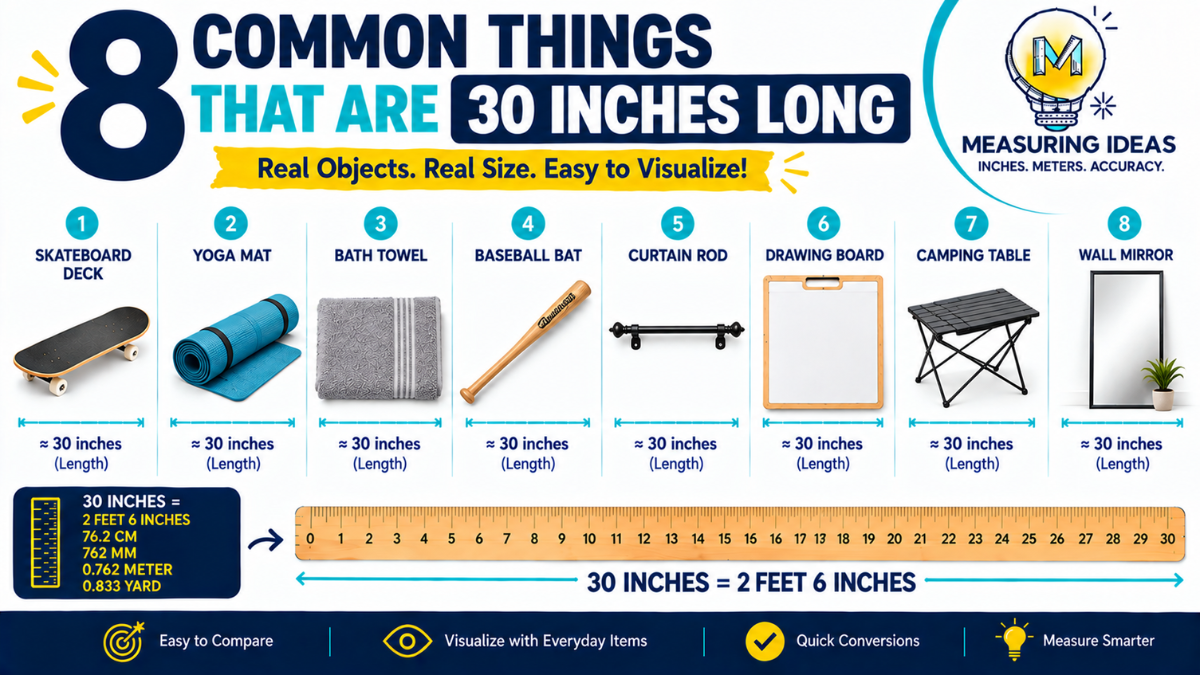
Thirty inches is equal to 2 feet 6 inches. In metric units, that is 76.2 centimeters, or 0.762 meters.
This length appears in many everyday products. You may find it in furniture, home improvement materials, sports equipment, household items, and storage solutions.
In this guide, we will look at 8 common things that are around 30 inches long. Each example gives you a different way to picture the distance.
Quick Answer: How Long Is 30 Inches?
30 inches equals 2 feet 6 inches.
Here are the most useful conversions:
- 30 inches = 2 feet 6 inches
- 30 inches = 76.2 centimeters
- 30 inches = 762 millimeters
- 30 inches = 0.762 meters
- 30 inches ≈ 0.833 yards
- 30 inches is 6 inches longer than 2 feet
- 30 inches is 6 inches shorter than 3 feet
- 30 inches is 2.54 centimeters shorter than 30.48 inches
For a simple visual reference, imagine a length of about 76 centimeters. It is a little longer than two feet but clearly shorter than three feet.
8 Common Things That Are Around 30 Inches Long
Here are eight different everyday objects that can have a dimension close to this measurement:
- A standard guitar neck section
- A kitchen drawer
- A large laptop screen width
- A bathroom vanity section
- A children’s balance beam
- A garden planter
- A suitcase
- A narrow bookshelf
The exact dimensions of these objects vary. Use them as visual comparisons, not as fixed standards.
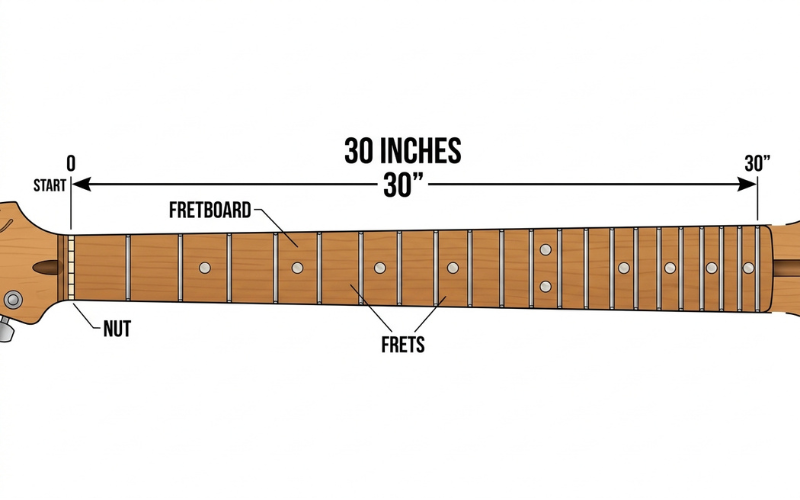
1. A Standard Guitar Neck Section 🎸
A guitar provides an interesting way to understand this length.
Many full-size guitars have an overall length well above 30 inches. However, certain parts of the instrument can approach this measurement, depending on the guitar’s design.
The long shape makes a guitar useful for thinking about distance.
Why a guitar helps with visualization
A guitar has a narrow body and a long neck. Its straight centerline creates an easy visual path from one end to another.
Imagine a section measuring slightly more than two feet. That gives you a useful mental picture of the distance.
Guitar sizes are different
Acoustic, electric, classical, and travel guitars do not all have the same dimensions.
Scale length is also different from the instrument’s total length. Therefore, check the specific measurement if you need an exact comparison.
2. A Kitchen Drawer 🍴
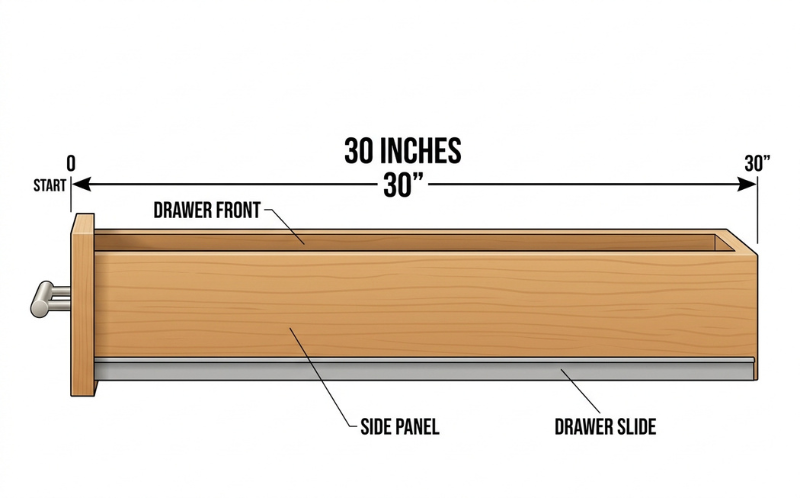
A wide kitchen drawer can measure close to 30 inches from side to side.
Large drawers are commonly used beneath countertops. They provide convenient storage for cooking utensils, cookware, dishes, and other kitchen supplies.
Why a drawer is a useful reference
A drawer has straight edges and a clearly defined width.
That makes it easier to imagine the measurement than an irregularly shaped object.
Picture a drawer stretching across roughly two and a half feet. The visual difference between its starting point and ending point gives you a practical sense of the length.
Drawer dimensions vary
Kitchen cabinets come in many widths.
A drawer might be much narrower or considerably wider depending on the cabinet system. The front panel can also differ from the usable interior space.
For a remodeling project, measure the cabinet opening rather than relying on a general size.
3. A Large Laptop Screen Width 💻
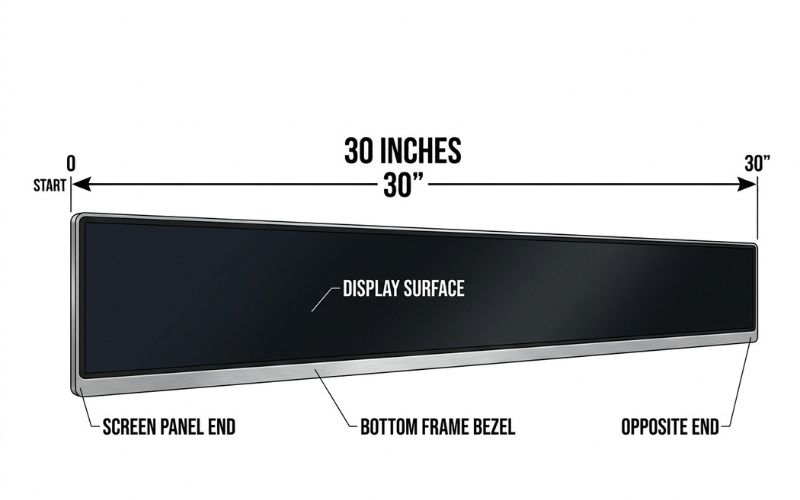
Some large desktop displays and laptop setups can have a horizontal dimension approaching 30 inches.
The screen itself may not measure exactly 30 inches across. However, a large display or monitor setup can give you a useful visual comparison.
Don’t confuse screen size with width
This is important.
Television and monitor sizes are usually described by diagonal screen measurement, not horizontal width.
For example, a screen advertised as 30 inches does not necessarily have a 30-inch-wide display.
Why the comparison still helps
A large screen gives you a familiar object with a broad horizontal surface.
When comparing physical space, always check the manufacturer’s listed width, height, and depth rather than assuming the advertised screen size represents its width.
4. A Bathroom Vanity Section 🚿
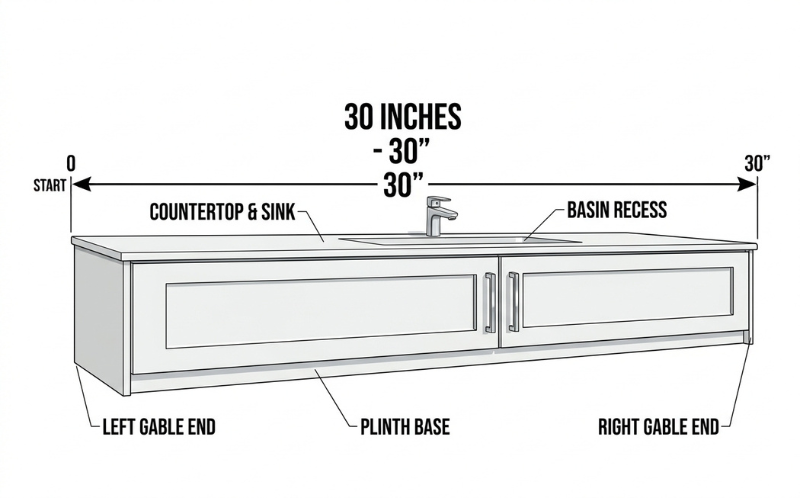
A bathroom vanity can have a width around 30 inches.
Compact vanities are common in smaller bathrooms. They can provide enough space for a sink, countertop, cabinet, and basic storage without occupying an entire wall.
What does this look like?
A vanity around this width spans roughly two and a half feet.
That is enough space to create a useful bathroom fixture while keeping the overall footprint relatively compact.
Vanity dimensions include several measurements
When shopping for one, pay attention to:
- Overall width
- Countertop depth
- Cabinet height
- Sink dimensions
- Faucet placement
- Door clearance
A vanity’s width alone does not tell you whether it will fit your bathroom.
5. A Children’s Balance Beam 🤸
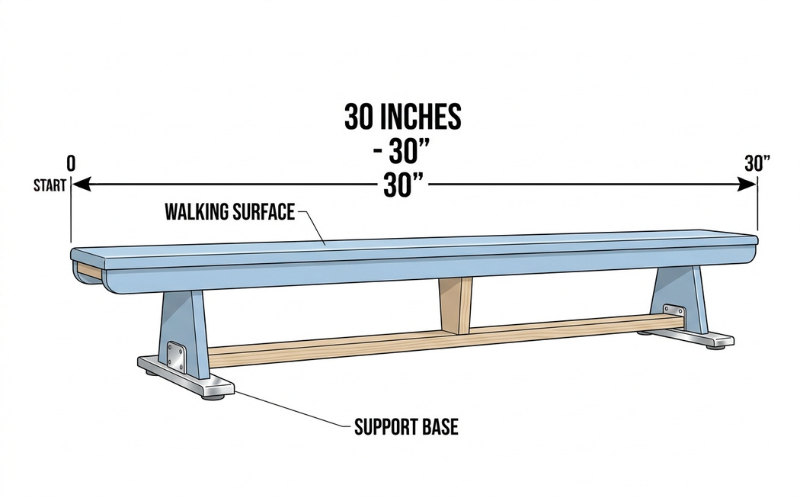
A small balance beam designed for children can have a length close to 30 inches.
These compact beams are made for simple balance exercises and indoor play. Their shorter size also makes them easier to store than full-size gym equipment.
Why this is an easy comparison
The beam is long and narrow.
Its straight shape provides a clear visual line. You can imagine extending a tape measure along its surface to see the approximate distance.
Safety matters
Children’s equipment should be used according to the manufacturer’s age, weight, and safety recommendations.
A homemade comparison should never be treated as a substitute for those specifications.
6. A Large Garden Planter 🌱
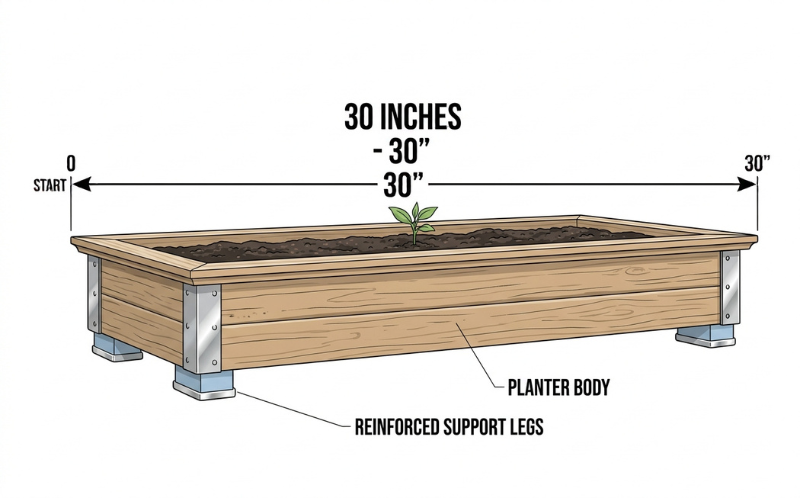
A rectangular garden planter may have a length close to 30 inches.
Long planters are useful for growing flowers, herbs, vegetables, and decorative plants.
Their shape also makes them easy to compare with a known measurement.
Why planters work as a visual reference
Most rectangular planters have straight sides.
A planter stretching about two and a half feet can occupy a noticeable amount of balcony, patio, porch, or garden space.
Imagine placing one beside a standard ruler. You would need two full 12-inch rulers plus another six inches to cover the length.
Consider the other dimensions
Length is only one part of a planter’s size.
Width and depth determine how much soil it can hold. Those dimensions also affect where you can place it.
7. A Suitcase 🧳
Some large suitcases can have a height or longest dimension close to 30 inches.
Luggage comes in many sizes, and larger checked bags can approach this range.
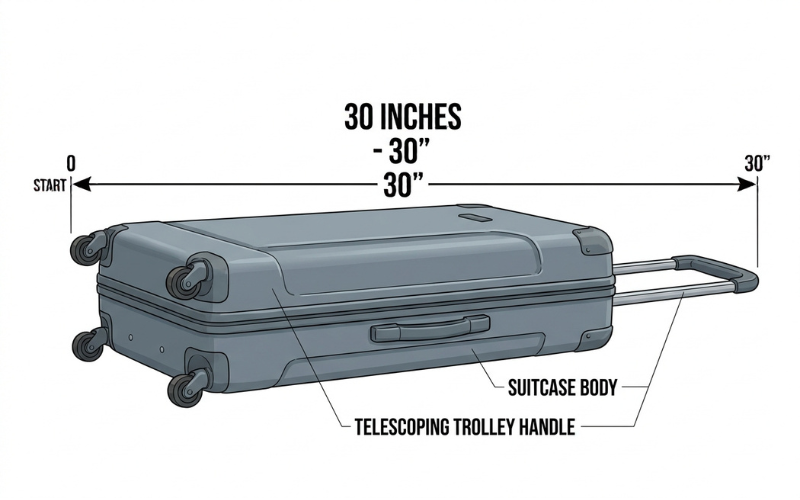
Why luggage makes sense as a comparison
Suitcases are familiar objects.
Most people have handled one, packed one, or seen one at an airport. That makes their dimensions easier to picture than an unfamiliar technical object.
A large suitcase standing upright can provide a useful visual approximation of this length.
Remember the wheels and handles
Manufacturers may list suitcase dimensions with or without certain external components.
Wheels, handles, and side pockets can affect the total outside size.
If you’re checking airline requirements, use the airline’s stated measurement rules and the manufacturer’s exact dimensions.
8. A Narrow Bookshelf 📚
A narrow bookshelf can measure approximately 30 inches across.
Shorter shelving units are useful in bedrooms, offices, hallways, children’s rooms, and small apartments.

How does it help you picture the length?
Place the shelf against a wall.
Its horizontal width gives you a clear sense of the distance. A unit around this size would span about two and a half feet.
Shelf width is only one factor
A bookshelf’s total capacity depends on its height and depth as well.
Two shelves with the same width can provide very different storage options if one is much taller.
For a tight space, measure the available wall area before choosing a unit.
How Long Is 30 Inches in Centimeters?
The conversion from inches to centimeters is straightforward.
One inch equals 2.54 centimeters.
Therefore:
30 × 2.54 = 76.2 centimeters
So:
30 inches = 76.2 cm
For quick estimates, you can think of the measurement as approximately 76 centimeters.
How Long Is 30 Inches in Millimeters?
One inch equals 25.4 millimeters.
The calculation is:
30 × 25.4 = 762 millimeters
Therefore:
30 inches = 762 mm
This conversion can be useful when reading technical specifications, furniture measurements, or product dimensions.
How Long Is 30 Inches in Meters?
To convert inches to meters, multiply by 0.0254.
The calculation is:
30 × 0.0254 = 0.762 meters
Therefore:
30 inches = 0.762 meters
For a rough estimate, you can round this to 0.76 meters.
How Long Is 30 Inches in Feet?
There are 12 inches in one foot.
Divide 30 by 12:
30 ÷ 12 = 2.5 feet
30 inches = 2.5 feet
Or, using the familiar feet-and-inches format:
30 inches = 2 feet 6 inches
Is 30 Inches More Than 2 Feet?
Yes.
Two feet equals 24 inches.
The difference is:
30 − 24 = 6 inches
So this measurement extends exactly half a foot beyond two feet.
That makes it particularly easy to visualize.
Is 30 Inches Less Than 3 Feet?
Yes.
Three feet equals 36 inches.
The difference is:
36 − 30 = 6 inches
Therefore, the measurement sits exactly halfway between 2 feet and 3 feet.
This is one of the simplest ways to remember it.
Is 30 Inches Halfway Between 2 and 3 Feet?
Yes. ✅
Two feet is 24 inches.
Three feet is 36 inches.
The difference between those measurements is 12 inches. Half of 12 is 6.
Adding six inches to 24 gives you 30.
So:
24 + 6 = 30 inches
That means the length is exactly 2.5 feet.
Is 30 Inches Close to 75 Centimeters?
Yes.
The exact metric value is 76.2 centimeters.
That is only 1.2 centimeters more than 75 cm.
For rough visualization, you can therefore think of the measurement as approximately 75–76 centimeters.
Is 30 Inches More Than Half a Meter?
Yes.
Half a meter is 50 centimeters.
The equivalent here is 76.2 centimeters.
The difference is:
76.2 − 50 = 26.2 centimeters
So it extends more than 26 centimeters beyond the half-meter mark.
How Long Is 30 Inches Compared With 29 Inches?
The difference is exactly 1 inch.
Since one inch equals 2.54 centimeters, the difference is 2.54 cm.
The two measurements are therefore quite close.
An object measuring 30 inches would only extend a small amount beyond a 29-inch object.
How Long Is 30 Inches Compared With 28 Inches?
The difference is:
30 − 28 = 2 inches
Two inches equals 5.08 centimeters.
That is enough to notice when objects are placed side by side, although the overall lengths remain fairly similar.
How Long Is 30 Inches Compared With 27 Inches?
Thirty inches is 3 inches longer than 27 inches.
Three inches equals 7.62 centimeters.
This comparison can be useful when choosing between similarly sized furniture or household products.
How Long Is 30 Inches Compared With 24 Inches?
Twenty-four inches equals exactly 2 feet.
The difference is:
30 − 24 = 6 inches
So the length is half a foot longer than the two-foot reference.
How Long Is 30 Inches Compared With 20 Inches?
The difference is:
30 − 20 = 10 inches
Ten inches equals 25.4 centimeters.
That makes the difference fairly noticeable when comparing two objects.
How Long Is 30 Inches Compared With 18 Inches?
The difference is 12 inches.
Since 12 inches equals one foot, an object measuring 30 inches is exactly one foot longer than an 18-inch object.
How Long Is 30 Inches Compared With 12 Inches?
Twelve inches equals one foot.
Thirty inches is therefore:
12 + 12 + 6 = 30 inches
So it measures 2 feet 6 inches.
Can You Measure 30 Inches Without a Ruler? 📏
You can estimate the distance without a measuring tool.
The result will not be exact, but several familiar references can make the process easier.
Use Two Feet as Your Starting Point
Two feet equals 24 inches.
You then need another six inches.
That gives you:
24 + 6 = 30 inches
This is probably the simplest mental method.
Use a 12-Inch Ruler
A standard ruler measures one foot.
Place two rulers end to end.
You now have 24 inches.
Add another half of a ruler, or six inches, to reach the target.
Think in Centimeters
If you are more comfortable with metric measurements, remember:
30 inches = 76.2 cm
For a quick estimate, 76 cm is close enough for many everyday comparisons.
The Easiest Way to Remember This Length 🧠
There is a very simple shortcut.
Think of 2 feet and 6 inches.
Another way to remember it is 2.5 feet.
For metric users, approximately 76 centimeters works well as a mental reference.
These three values cover most everyday situations:
30 inches = 2 feet 6 inches
30 inches = 2.5 feet
30 inches = 76.2 centimeters
Why Comparing Measurements With Everyday Objects Helps
Numbers can be difficult to visualize.
A familiar object provides physical context.
For example, imagining a kitchen drawer or bookshelf that spans about two and a half feet gives you a much better sense of the distance.
This type of comparison can help when:
- Shopping online
- Planning furniture placement
- Measuring storage areas
- Choosing home accessories
- Working on DIY projects
- Comparing product dimensions
- Organizing a room
- Estimating available space
Visual estimates are useful for planning. They should not replace precise measurements when accuracy matters.
A Simple Measurement Challenge 🎯
Try a quick experiment at home.
Choose several objects and estimate their length before measuring them.
Put each one into one of these groups:
- Less than 30 inches
- Around 30 inches
- More than 30 inches
Then check your guesses with a tape measure.
This exercise can improve your ability to judge everyday dimensions without constantly reaching for a measuring tool.
Why Common Objects Are Not Always Exactly 30 Inches
The examples above are around this length, rather than guaranteed to measure exactly 30 inches.
Product dimensions can vary widely.
A bookshelf from one manufacturer may be 29 inches wide. Another model could be 31 inches. Both can still be useful for visualizing a measurement around this range.
Several factors affect dimensions
Size can depend on:
- Brand
- Product model
- Intended purpose
- Construction
- Materials
- Adjustable features
- Manufacturing standards
Because of these differences, always check the specifications of a particular product before making a purchase.
Measure the complete object
Some products have parts that extend beyond their main body.
Examples include:
- Handles
- Wheels
- Frames
- Hinges
- Legs
- Lids
- Brackets
If the item needs to fit into a particular space, measure its maximum outside dimensions.
Where You Might Encounter a 30-Inch Measurement
Kitchen and Bathroom
Drawers, vanities, cabinets, and storage fixtures can have dimensions close to this length.
Home and Furniture
Bookshelves, tables, shelves, and other furniture components can fall within this range.
Sports and Recreation
Certain pieces of sports equipment may approach this measurement.
Gardening
Long planters and garden boxes can provide another familiar example.
Travel
Large luggage pieces may have a longest dimension around this size.
30 Inches in Different Units
| Unit | Equivalent |
| Inches | 30 in |
| Feet | 2.5 ft |
| Feet + inches | 2 ft 6 in |
| Centimeters | 76.2 cm |
| Millimeters | 762 mm |
| Meters | 0.762 m |
| Yards | 0.8333 yd |
| Approximate centimeters | 76 cm |
| Difference from 29 inches | 1 inch |
| Difference from 28 inches | 2 inches |
| Difference from 27 inches | 3 inches |
| Difference from 26 inches | 4 inches |
| Difference from 25 inches | 5 inches |
| Difference from 24 inches | 6 inches |
| Difference from 23 inches | 7 inches |
| Difference from 22 inches | 8 inches |
| Difference from 21 inches | 9 inches |
| Difference from 20 inches | 10 inches |
| Difference from 18 inches | 12 inches |
| Difference from 16 inches | 14 inches |
| Difference from 12 inches | 18 inches |
30-Inch Comparison Chart
| Measurement | Difference from 30 inches |
| 8 inches | 22 inches shorter |
| 10 inches | 20 inches shorter |
| 12 inches | 18 inches shorter |
| 14 inches | 16 inches shorter |
| 15 inches | 15 inches shorter |
| 16 inches | 14 inches shorter |
| 17 inches | 13 inches shorter |
| 18 inches | 12 inches shorter |
| 19 inches | 11 inches shorter |
| 20 inches | 10 inches shorter |
| 21 inches | 9 inches shorter |
| 22 inches | 8 inches shorter |
| 23 inches | 7 inches shorter |
| 24 inches | 6 inches shorter |
| 25 inches | 5 inches shorter |
| 26 inches | 4 inches shorter |
| 27 inches | 3 inches shorter |
| 28 inches | 2 inches shorter |
| 29 inches | 1 inch shorter |
| 30 inches | Reference length |
| 31 inches | 1 inch longer |
| 32 inches | 2 inches longer |
| 36 inches | 6 inches longer |
| 48 inches | 18 inches longer |
Biowiki Table: 30-Inch Measurement at a Glance
| Measurement | Equivalent |
| Length | 30 inches |
| Feet | 2.5 feet |
| Feet + inches | 2 feet 6 inches |
| Centimeters | 76.2 cm |
| Millimeters | 762 mm |
| Meters | 0.762 m |
| Yards | 0.8333 yd |
| Approximate metric value | 76 cm |
| Difference from 29 inches | 1 inch |
| Difference from 28 inches | 2 inches |
| Difference from 27 inches | 3 inches |
| Difference from 26 inches | 4 inches |
| Difference from 25 inches | 5 inches |
| Difference from 24 inches | 6 inches |
| Difference from 23 inches | 7 inches |
| Difference from 22 inches | 8 inches |
| Difference from 21 inches | 9 inches |
| Difference from 20 inches | 10 inches |
| Difference from 18 inches | 12 inches |
| Difference from 16 inches | 14 inches |
| Difference from 12 inches | 18 inches |
| Half of the length | 15 inches |
| Double the length | 60 inches |
Frequently Asked Questions
How long is 30 inches?
30 inches equals 2 feet 6 inches. In metric units, the same length is 76.2 centimeters, 762 millimeters, or 0.762 meters.
What common things are around 30 inches long?
Examples include kitchen drawers, compact bathroom vanities, large planters, suitcases, bookshelves, and certain pieces of sports or recreational equipment.
Is 30 inches more than 2 feet?
Yes. Two feet equals 24 inches, so the measurement is 6 inches longer than two feet.
Is 30 inches less than 3 feet?
Yes. Three feet equals 36 inches, making the measurement 6 inches shorter than three feet.
Is 30 inches exactly 2.5 feet?
Yes. Since one foot contains 12 inches, 30 inches equals 2.5 feet.
Final Thoughts
Understanding how long is 30 inches becomes much easier when you connect the measurement to objects you see every day.
A kitchen drawer, planter, suitcase, bookshelf, bathroom vanity, or recreational item can provide a useful visual reference. 📏
The key conversions are simple:
30 inches = 2 feet 6 inches
30 inches = 76.2 centimeters
30 inches = 762 millimeters
30 inches = 0.762 meters
For a quick estimate, remember about 76 centimeters or two and a half feet. When an exact fit matters, however, use a tape measure rather than relying on an object comparison.
More to Explore
8 Common Things That Are 29 Inches Long