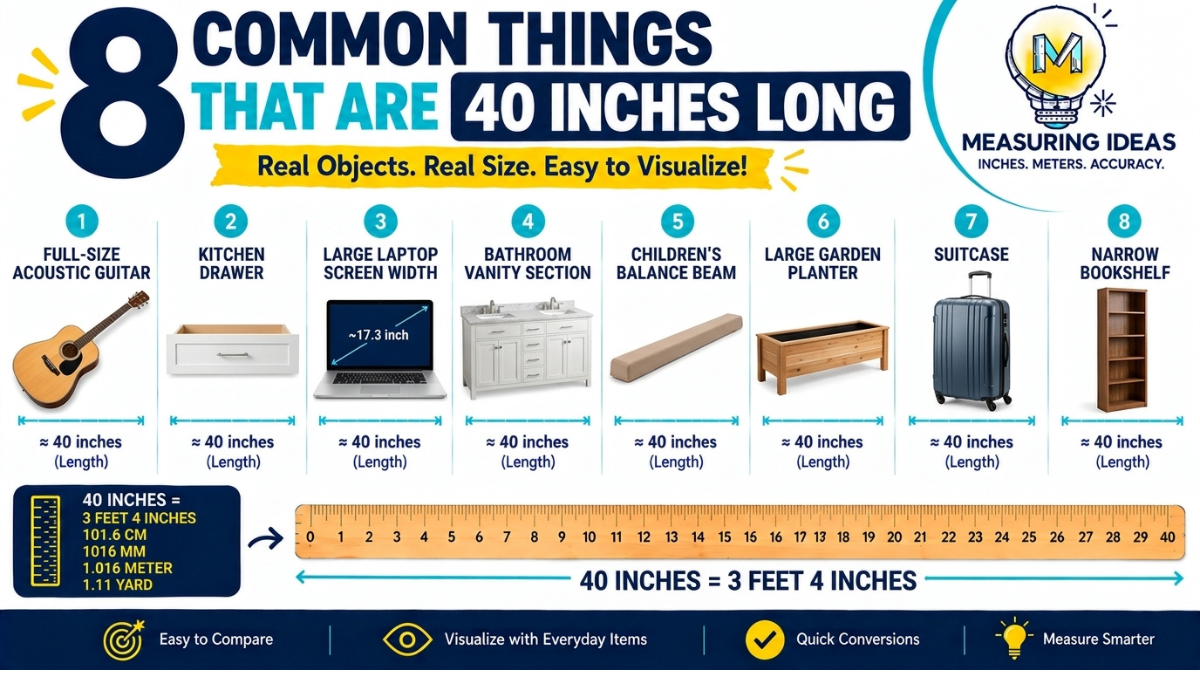
If you are trying to understand how long is 40 inches, a number alone may not give you a clear visual idea. Comparing the measurement with familiar objects makes it much easier to picture.
Forty inches equals 3 feet 4 inches. In metric units, that is 101.6 centimeters, or just over 1 meter.
This length appears in many everyday items. You may encounter it in musical instruments, furniture, home accessories, exercise equipment, and household fixtures.
In this guide, we will explore 8 common things that are around 40 inches long. Each example gives you a practical way to visualize the distance without depending on the same comparison every time.
Quick Answer: How Long Is 40 Inches?
40 inches is equal to 3 feet 4 inches.
Here are the main conversions:
- 40 inches = 3 feet 4 inches
- 40 inches = 101.6 centimeters
- 40 inches = 1,016 millimeters
- 40 inches = 1.016 meters
- 40 inches ≈ 1.111 yards
- It is 4 inches longer than 3 feet
- It is 8 inches shorter than 4 feet
- It is 10 inches longer than 30 inches
- It is 20 inches longer than 20 inches
For a simple visual reference, think of slightly more than one meter. In the imperial system, picture a little over three feet.
8 Common Things That Are Around 40 Inches Long
Here are eight useful everyday comparisons:
- A full-size acoustic guitar
- A compact ironing board
- A small folding table
- A curtain rod
- A children’s balance beam
- A narrow full-length mirror
- A short kitchen countertop section
- A large floor cushion or bench
The exact size of each item can vary. These objects are best used as approximate visual references rather than exact measuring standards.
1. A Full-Size Acoustic Guitar 🎸
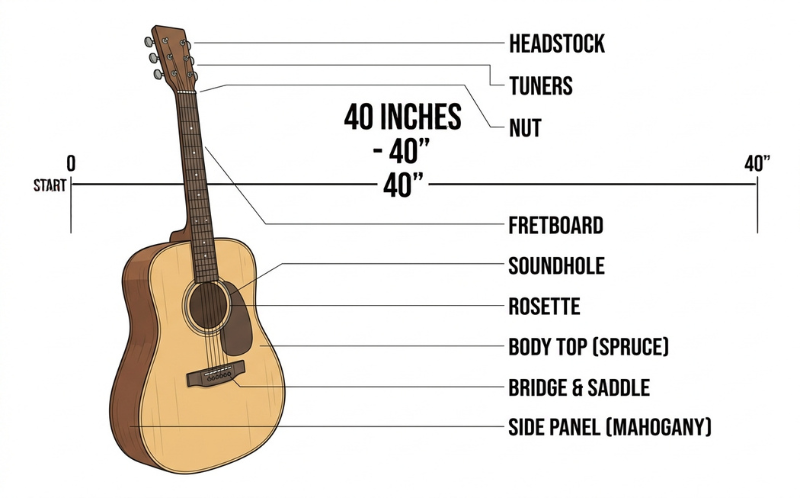
A full-size acoustic guitar is one of the easiest objects to use as a visual reference.
Many acoustic guitars have an overall length somewhere around the 40-inch range, although the exact measurement depends on the body design, neck, and manufacturer.
Why a guitar is a useful comparison
A guitar has a long, recognizable shape.
Its neck and body form one continuous object, so you can easily imagine the distance from the headstock to the bottom of the body.
Place a guitar vertically on the floor and picture a little over three feet. That gives you a practical sense of this measurement.
Guitar dimensions can differ
Not every guitar has the same overall length.
Travel guitars are usually shorter, while some larger acoustic models can be longer. Scale length is also different from the instrument’s total length.
For an exact measurement, check the manufacturer’s specifications.
2. A Compact Ironing Board 👕
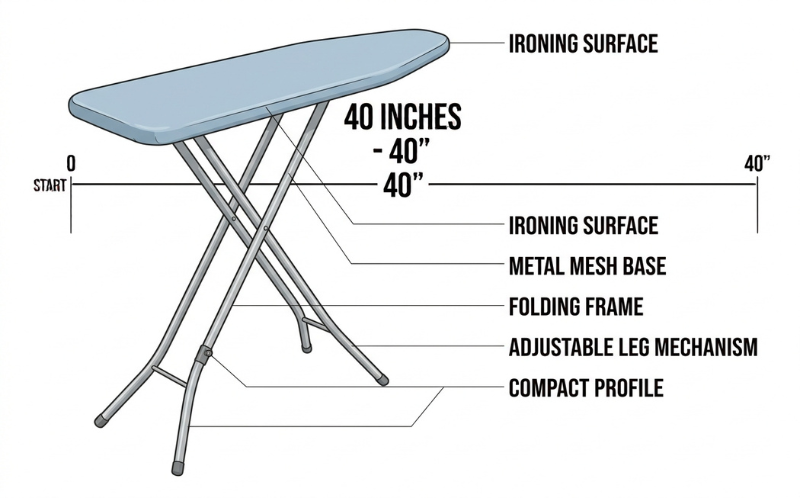
Some compact ironing boards can have an overall length close to 40 inches.
These boards are designed for everyday clothing care while taking up less storage space than larger models.
How an ironing board helps you visualize the size
An ironing board has a long, narrow surface.
Its length is easy to see because the two ends are clearly defined.
Imagine stretching a tape measure from the rounded front to the opposite end. A compact model measuring around 40 inches would cover more than three feet.
Ironing boards come in many sizes
Full-size ironing boards can be longer than this.
Tabletop models are much shorter.
The board’s width also affects how spacious it feels during use. Therefore, look at the complete dimensions if you are buying one for a particular room or storage area.
3. A Small Folding Table 🪑
A compact folding table can measure approximately 40 inches along its longest side.
These tables are useful when you need temporary workspace without keeping a large piece of furniture in the room.
Where can you use one?
A small folding table can work well for:
- Outdoor meals
- Craft projects
- Home offices
- Parties
- Garage activities
- Camping
- Extra dining space
A tabletop stretching about three feet four inches gives you a useful picture of the measurement.
Table dimensions are not always straightforward
Some folding tables have rounded corners.
Others have folding legs that extend beyond the tabletop.
If the table needs to fit into a vehicle or storage area, check its folded and unfolded dimensions separately.
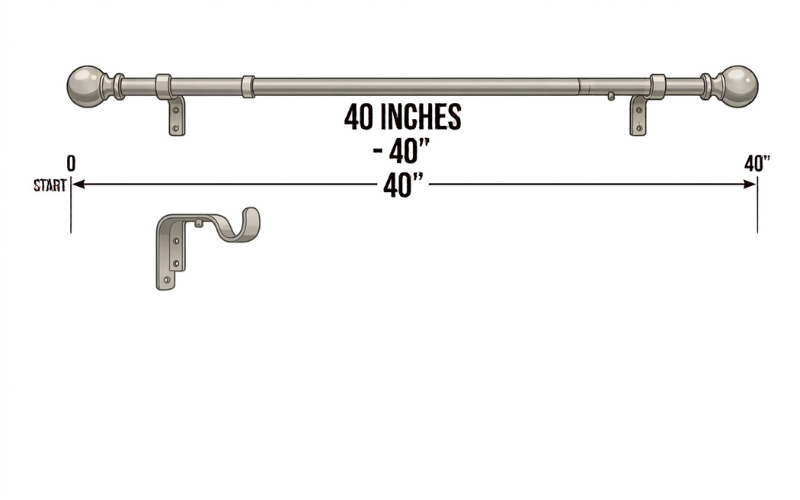
4. A Curtain Rod 🪟
A curtain rod can be close to 40 inches when adjusted to a particular length.
Many rods are telescoping, which means they can extend or contract to fit different windows.
Why it makes a good reference
A curtain rod is long and straight.
That makes it easy to compare with a ruler or measuring tape.
Imagine a rod extending just over three feet across a window. That visual can help you understand the overall distance.
Adjustable rods need special attention
A rod advertised with a range such as 28–48 inches does not have one fixed length.
Its final size depends on how far you extend it.
For a precise comparison, use the actual installed length rather than the maximum advertised dimension.
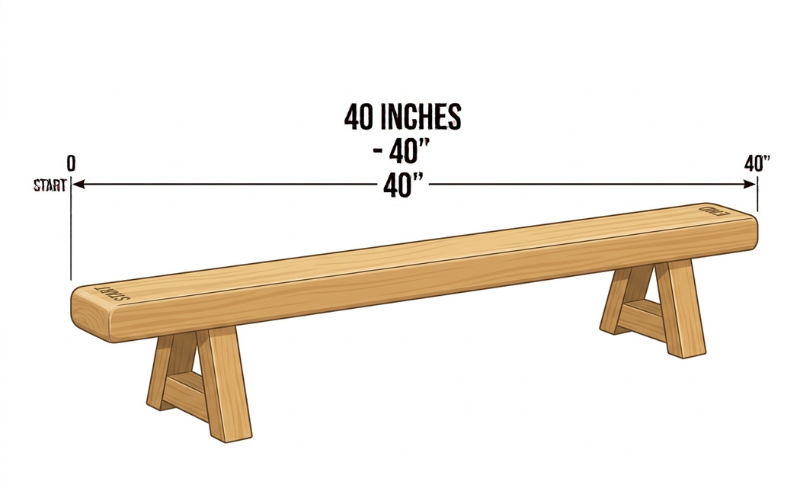
5. A Children’s Balance Beam 🤸
Some children’s balance beams are designed with lengths close to 40 inches.
These compact versions are intended for simple balance practice and indoor activities.
Why this is a helpful comparison
A balance beam is long and narrow.
Its straight profile gives you a clear visual line.
Picture a beam stretching from one end to another across a little more than three feet. That gives you a good physical reference for the measurement.
Safety should come first
Children’s equipment should always be used according to the manufacturer’s instructions.
Weight limits, recommended ages, surface requirements, and supervision guidelines can vary between products.
The comparison here is only intended to help visualize length.
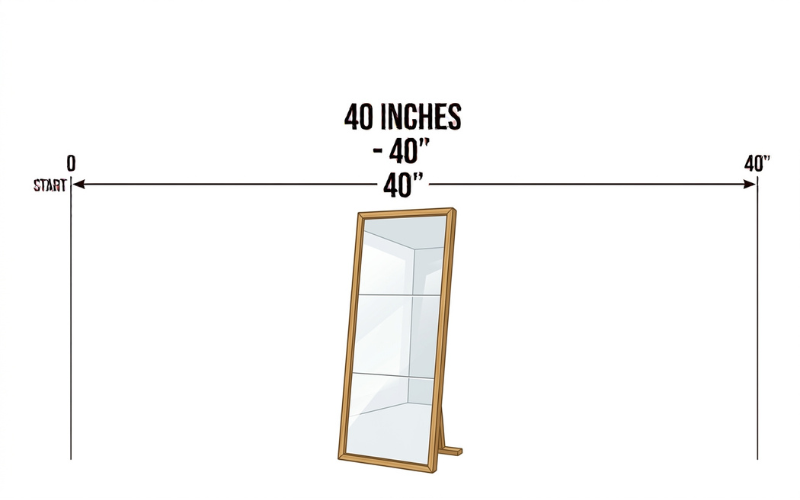
6. A Narrow Full-Length Mirror 🪞
A narrow mirror can have a height close to 40 inches.
Although many full-length mirrors are taller, smaller standing or wall-mounted designs can have a dimension around this range.
Why a mirror is easy to picture
A mirror usually has a rectangular shape.
Its straight edges make the height or width simple to compare with a known measurement.
Imagine a mirror extending slightly more than one meter from top to bottom. That is roughly the metric equivalent of this length.
Don’t forget the frame
A mirror’s listed glass dimensions may differ from its overall outside dimensions.
A thick decorative frame can add several inches to the total size.
If the mirror needs to fit inside a specific space, measure the entire outside edge.
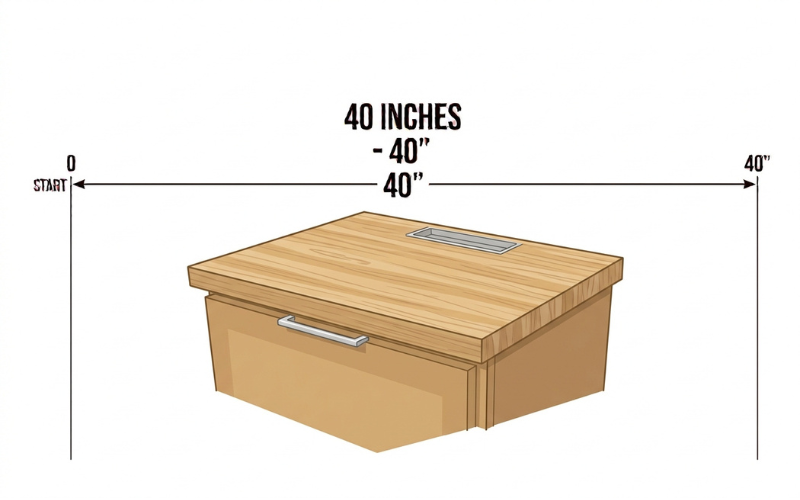
7. A Short Kitchen Countertop Section 🍳
A section of kitchen countertop can measure around 40 inches in length.
Countertops are usually installed in much longer sections, but individual sections between appliances, corners, sinks, or cabinets can be close to this measurement.
Why countertops provide a useful comparison
A countertop is a familiar horizontal surface.
Look at the distance from one point along the counter to another. A span of about three feet four inches is easier to imagine when you see it in a real kitchen.
Countertop measurements involve more than length
Depth is also important.
A typical countertop is much wider than a narrow shelf, so the overall surface area can be substantial even when one section measures around 40 inches.
If you are planning a renovation, measure the wall, cabinets, appliances, and available clearance before ordering materials.
8. A Large Bench or Floor Cushion 🛋️
A long bench or oversized floor cushion can have a length close to 40 inches.
These pieces are often used in bedrooms, entryways, living rooms, and other spaces where additional seating is needed.
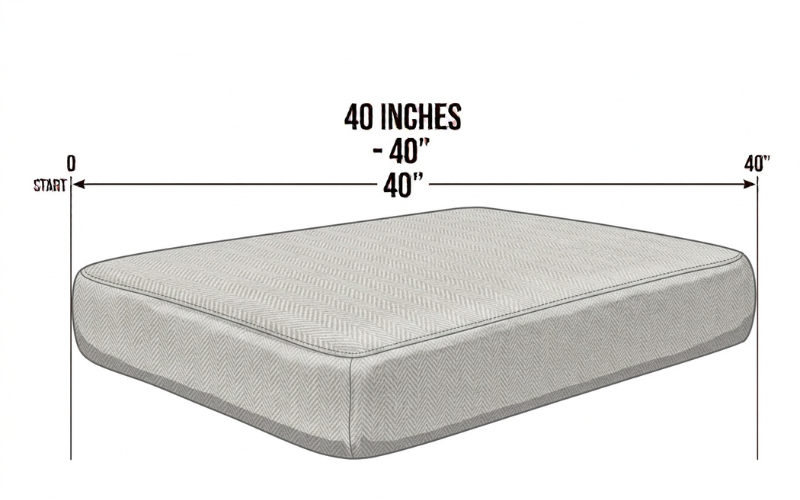
Why this makes a practical comparison
A bench gives you a clear horizontal reference.
Imagine sitting on a piece of furniture that stretches a little over three feet from one side to the other.
That is a simple way to develop a mental picture of the distance.
Furniture sizes vary
A bench may have a similar length but a very different width or height.
The thickness of a cushion can also change the overall proportions.
Always check all three dimensions before deciding whether a piece will fit.
How Long Is 40 Inches in Centimeters?
The conversion is simple because one inch equals 2.54 centimeters.
Multiply:
40 × 2.54 = 101.6 centimeters
Therefore:
40 inches = 101.6 cm
For everyday estimation, you can round that to approximately 102 centimeters.
That makes the measurement just slightly longer than one meter.
How Long Is 40 Inches in Millimeters?
One inch contains 25.4 millimeters.
So:
40 × 25.4 = 1,016 millimeters
Therefore:
40 inches = 1,016 mm
This unit is useful when working with detailed product specifications or technical measurements.
How Long Is 40 Inches in Meters?
To convert inches to meters, multiply by 0.0254.
The calculation is:
40 × 0.0254 = 1.016 meters
Therefore:
40 inches = 1.016 meters
For a quick mental estimate, you can think of about 1.02 meters.
How Long Is 40 Inches in Feet?
There are 12 inches in one foot.
Divide 40 by 12:
40 ÷ 12 = 3.333 feet
In the familiar feet-and-inches format:
40 inches = 3 feet 4 inches
This is often easier to visualize than the decimal value.
Is 40 Inches More Than 3 Feet?
Yes.
Three feet equals 36 inches.
The difference is:
40 − 36 = 4 inches
So the measurement is exactly 4 inches longer than three feet.
That makes the comparison easy to remember.
Is 40 Inches Less Than 4 Feet?
Yes.
Four feet equals 48 inches.
The difference is:
48 − 40 = 8 inches
So the distance is 8 inches shorter than four feet.
It sits between three and four feet.
Is 40 Inches More Than 1 Meter?
Yes, but only slightly.
One meter equals 39.37 inches.
The difference is approximately:
40 − 39.37 = 0.63 inches
So the measurement is about 0.63 inches longer than one meter.
This is why thinking of it as roughly one meter is a useful quick estimate.
Is 40 Inches Close to 100 Centimeters?
Yes.
The exact value is 101.6 centimeters.
That means it is only 1.6 centimeters longer than 100 cm.
For rough everyday visualization, you can think of the length as approximately one meter.
How Long Is 40 Inches Compared With 30 Inches?
The difference is:
40 − 30 = 10 inches
Ten inches equals 25.4 centimeters.
So an object measuring 40 inches is noticeably longer than one measuring 30 inches.
The difference is almost the length of a standard school ruler.
How Long Is 40 Inches Compared With 36 Inches?
Thirty-six inches equals exactly 3 feet.
The difference is:
40 − 36 = 4 inches
That means the longer measurement extends only four inches beyond the three-foot mark.
How Long Is 40 Inches Compared With 24 Inches?
Twenty-four inches equals 2 feet.
The difference is:
40 − 24 = 16 inches
Therefore, the longer measurement extends 1 foot 4 inches beyond the two-foot mark.
How Long Is 40 Inches Compared With 20 Inches?
Forty inches is exactly 20 inches longer than 20 inches.
It is also exactly twice as long as a 20-inch measurement.
That makes this comparison especially simple.
How Long Is 40 Inches Compared With 12 Inches?
Twelve inches equals one foot.
You can break the measurement down like this:
12 + 12 + 12 + 4 = 40 inches
So it equals 3 feet 4 inches.
This is a useful way to visualize the length using one-foot sections.
Can You Measure 40 Inches Without a Ruler? 📏
You can estimate it using familiar references.
The result may not be exact, but these methods can help you get reasonably close.
Use Three Feet as a Starting Point
Three feet equals 36 inches.
Add another four inches:
36 + 4 = 40 inches
This is probably the easiest mental shortcut.
Use a Standard 12-Inch Ruler
Three rulers placed end to end equal:
12 + 12 + 12 = 36 inches
You then need another four inches.
That gives you the complete distance.
Think in Meters
If metric measurements are more familiar to you, remember that the length is 1.016 meters.
For a quick estimate, simply think about one meter.
The Easiest Way to Remember This Length 🧠
You only need a few conversions.
Remember these three:
40 inches = 3 feet 4 inches
40 inches = 101.6 centimeters
40 inches = 1.016 meters
For a quick visual estimate, think of slightly more than one meter.
If you prefer imperial measurements, picture three feet plus four inches.
Why Everyday Objects Make Measurements Easier
A measurement can feel abstract when it appears only as a number.
Familiar objects add context.
A guitar, folding table, ironing board, or mirror gives your brain a physical reference that is easier to remember.
These comparisons can be useful when:
- Shopping online
- Planning furniture placement
- Measuring storage space
- Choosing home accessories
- Working on DIY projects
- Comparing product dimensions
- Planning a room layout
- Estimating available space
Visual estimates are helpful for planning. For an exact fit, however, a measuring tool is still the better choice.
A Simple Measurement Challenge 🎯
Try this at home.
Choose a few objects that look close to this size.
Before measuring them, decide whether each one is:
- Shorter than 40 inches
- Around 40 inches
- Longer than 40 inches
Write down your guesses.
Then use a tape measure to check them.
This simple exercise can help improve your ability to estimate everyday lengths.
Why Common Objects Are Not Always Exactly 40 Inches
The examples in this article are approximate comparisons.
They should not be treated as universal standards.
A guitar from one manufacturer may be 39 inches long, while another could be 41 inches. The same variation can occur with tables, mirrors, ironing boards, and other household products.
Product dimensions can vary
Several factors affect an object’s size:
- Manufacturer
- Product model
- Design
- Intended use
- Materials
- Adjustable features
- Construction
For this reason, always check the exact specifications when accuracy matters.
Measure the complete object
Some items have components that extend beyond the main body.
These may include:
- Handles
- Frames
- Legs
- Wheels
- Brackets
- Hinges
- Decorative edges
If an object must fit into a particular space, measure its maximum outside dimensions.
Where You Might Encounter a 40-Inch Measurement
Musical Instruments 🎸
Some full-size guitars have an overall length close to this measurement.
Home Improvement 🔨
Countertop sections, curtain rods, and other household fixtures can fall around this range.
Furniture 🪑
Compact tables, benches, and similar furniture pieces may have a side close to this length.
Household Equipment
Ironing boards and other home products can provide another useful comparison.
Fitness and Recreation 🤸
Compact children’s balance equipment may have dimensions around this size.
40 Inches in Different Units
| Unit | Equivalent |
| Inches | 40 in |
| Feet | 3.3333 ft |
| Feet + inches | 3 ft 4 in |
| Centimeters | 101.6 cm |
| Millimeters | 1,016 mm |
| Meters | 1.016 m |
| Yards | 1.1111 yd |
| Approximate centimeters | 102 cm |
| Difference from 39 inches | 1 inch |
| Difference from 38 inches | 2 inches |
| Difference from 37 inches | 3 inches |
| Difference from 36 inches | 4 inches |
| Difference from 30 inches | 10 inches |
| Difference from 29 inches | 11 inches |
| Difference from 28 inches | 12 inches |
| Difference from 27 inches | 13 inches |
| Difference from 26 inches | 14 inches |
| Difference from 25 inches | 15 inches |
| Difference from 24 inches | 16 inches |
| Difference from 20 inches | 20 inches |
| Difference from 12 inches | 28 inches |
40-Inch Comparison Chart
| Measurement | Difference from 40 inches |
| 8 inches | 32 inches shorter |
| 10 inches | 30 inches shorter |
| 12 inches | 28 inches shorter |
| 14 inches | 26 inches shorter |
| 15 inches | 25 inches shorter |
| 16 inches | 24 inches shorter |
| 18 inches | 22 inches shorter |
| 20 inches | 20 inches shorter |
| 21 inches | 19 inches shorter |
| 22 inches | 18 inches shorter |
| 23 inches | 17 inches shorter |
| 24 inches | 16 inches shorter |
| 25 inches | 15 inches shorter |
| 26 inches | 14 inches shorter |
| 27 inches | 13 inches shorter |
| 28 inches | 12 inches shorter |
| 29 inches | 11 inches shorter |
| 30 inches | 10 inches shorter |
| 32 inches | 8 inches shorter |
| 36 inches | 4 inches shorter |
| 39 inches | 1 inch shorter |
| 40 inches | Reference length |
| 41 inches | 1 inch longer |
| 42 inches | 2 inches longer |
| 48 inches | 8 inches longer |
Biowiki Table: 40-Inch Measurement at a Glance
| Measurement | Equivalent |
| Length | 40 inches |
| Feet | 3.3333 feet |
| Feet + inches | 3 feet 4 inches |
| Centimeters | 101.6 cm |
| Millimeters | 1,016 mm |
| Meters | 1.016 m |
| Yards | 1.1111 yd |
| Approximate metric value | 102 cm |
| Difference from 39 inches | 1 inch |
| Difference from 38 inches | 2 inches |
| Difference from 37 inches | 3 inches |
| Difference from 36 inches | 4 inches |
| Difference from 30 inches | 10 inches |
| Difference from 29 inches | 11 inches |
| Difference from 28 inches | 12 inches |
| Difference from 27 inches | 13 inches |
| Difference from 26 inches | 14 inches |
| Difference from 25 inches | 15 inches |
| Difference from 24 inches | 16 inches |
| Difference from 20 inches | 20 inches |
| Difference from 12 inches | 28 inches |
| Half of the length | 20 inches |
| Double the length | 80 inches |
Frequently Asked Questions
How long is 40 inches?
40 inches equals 3 feet 4 inches. In metric units, it is 101.6 centimeters, 1,016 millimeters, or 1.016 meters.
What common things are around 40 inches long?
Examples include some full-size acoustic guitars, compact ironing boards, small folding tables, curtain rods, children’s balance beams, narrow mirrors, countertop sections, and benches.
Is 40 inches more than 3 feet?
Yes. Three feet equals 36 inches, so this measurement is 4 inches longer than three feet.
Is 40 inches less than 4 feet?
Yes. Four feet equals 48 inches, making the measurement 8 inches shorter than four feet.
Is 40 inches more than 1 meter?
Yes. One meter equals approximately 39.37 inches, so this length is about 0.63 inches longer than one meter.
Final Thoughts
Understanding how long is 40 inches becomes much easier when you compare the measurement with familiar objects.
A guitar, ironing board, folding table, curtain rod, mirror, countertop section, or bench can give you a practical visual reference. 📏
The key conversions are simple:
40 inches = 3 feet 4 inches
40 inches = 101.6 centimeters
40 inches = 1,016 millimeters
40 inches = 1.016 meters
For a quick estimate, think of slightly more than one meter. When precision matters, use a ruler or tape measure because the actual dimensions of everyday objects can vary.
More to Explore
8 Common Things That Are 29 Inches Long