
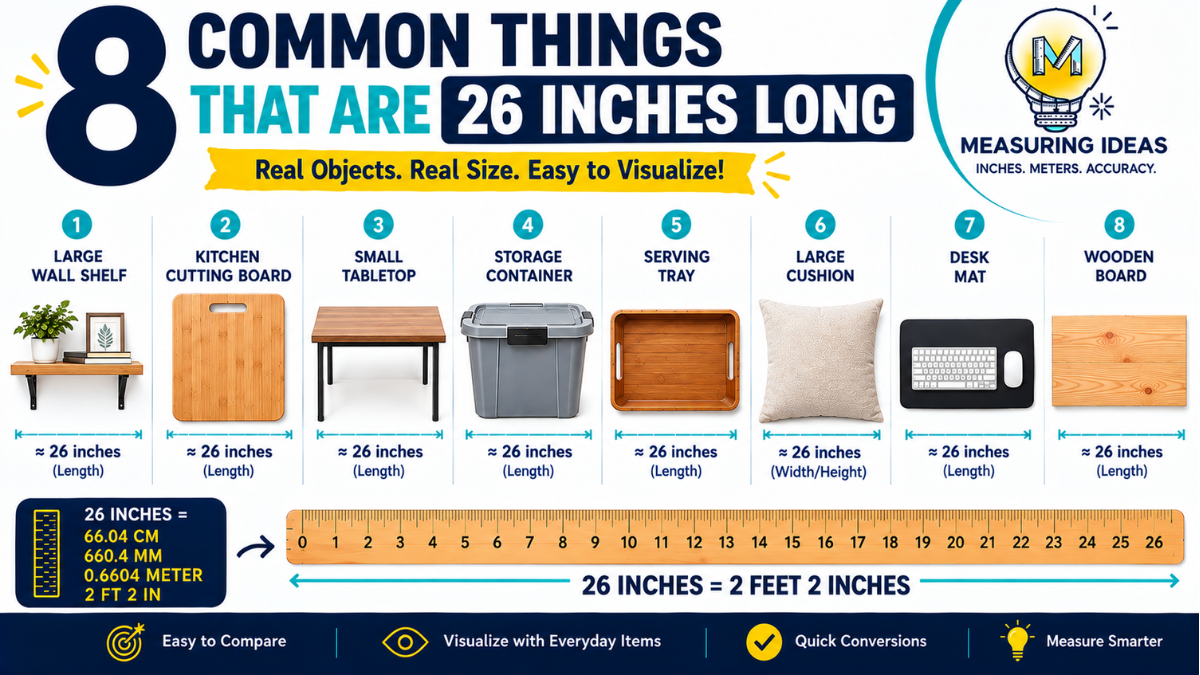
If you are trying to understand how long is 26 inches, everyday objects can make the measurement much easier to visualize. A number by itself does not always give you a clear sense of size.
Twenty-six inches is equal to 2 feet 2 inches, or 66.04 centimeters. It is slightly longer than two feet, making it a useful measurement for furniture, shelves, kitchen items, storage products, and other household objects.
In this guide, we will look at 8 common things that are around 26 inches long. You will also find simple conversions, comparisons, measurement tips, and practical examples to help you picture this length. 📏
Quick Answer: How Long Is 26 Inches?
26 inches is exactly 2 feet and 2 inches long.
Here are the most useful conversions:
- 26 inches = 2 feet 2 inches
- 26 inches = 66.04 centimeters
- 26 inches = 660.4 millimeters
- 26 inches = 0.6604 meters
- 26 inches ≈ 0.72 yards
- 26 inches is 2 inches longer than 2 feet
- 26 inches is 2 inches longer than 24 inches
- 26 inches is 1 inch longer than 25 inches
- 26 inches is 6 inches longer than 20 inches
- 26 inches is 14 inches longer than 12 inches
For a quick visual estimate, think of about 66 centimeters, or a little more than 2 feet.
8 Common Things That Are Around 26 Inches Long
Several familiar objects can have a dimension close to this measurement:
- A large wall shelf
- A wide cutting board
- A small tabletop
- A large storage bin
- A serving tray
- A large cushion
- A desk mat
- A wooden board
Keep in mind that these are examples rather than fixed standards. The actual dimensions can differ depending on the product, manufacturer, and design.
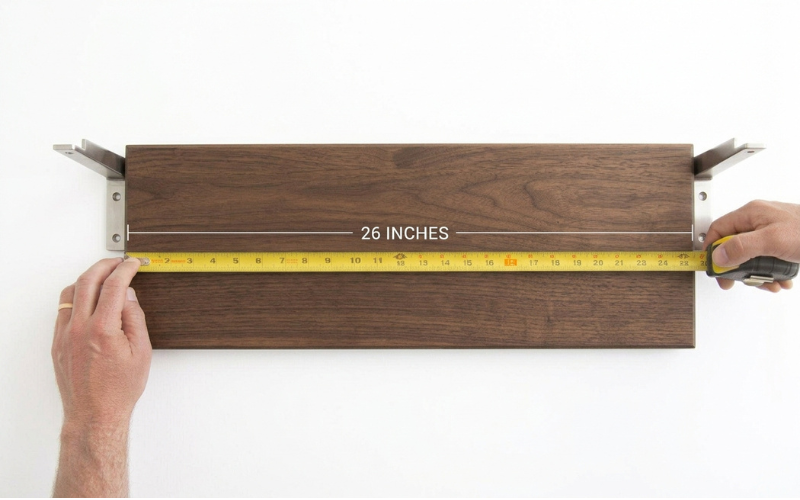
1. Large Wall Shelf 🏠
A large wall shelf can be around 26 inches long.
Shelves in this range are common in bedrooms, living rooms, kitchens, offices, and hallways. They provide useful storage while remaining compact enough for many walls.
A shelf measuring about 26 inches can hold several small items without requiring a large amount of space.
What can you put on a shelf this size?
Depending on its depth, it could hold:
- Books
- Small plants
- Picture frames
- Candles
- Collectibles
- Small storage boxes
- Decorations
- Office supplies
The straight front edge also makes a shelf easy to use as a visual reference.
Why it is a useful comparison
Imagine a shelf that is exactly 2 feet long.
Now add 2 inches.
You have 26 inches.
That means this length is noticeably longer than a standard 24-inch shelf, but the difference is still fairly small.
2. Wide Kitchen Cutting Board 🥕
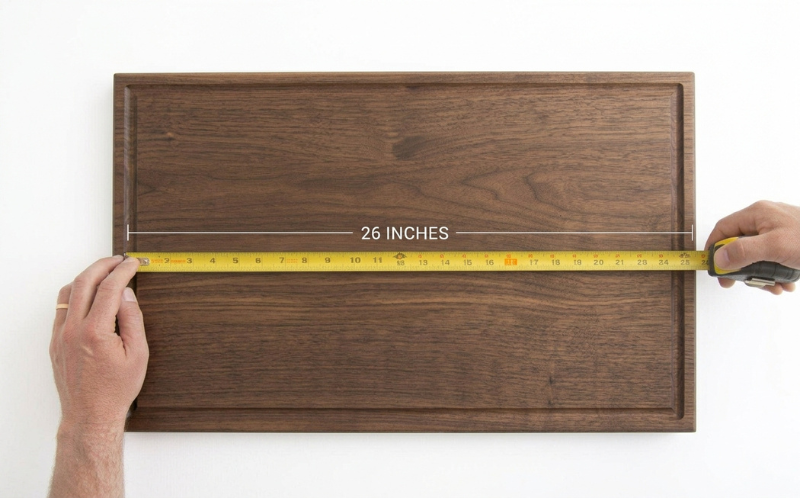
A large cutting board can have a longest dimension close to 26 inches.
Kitchen cutting boards come in many sizes. Small boards work well for quick preparation, while larger versions provide plenty of room for chopping vegetables, slicing bread, preparing ingredients, and organizing food.
A wide rectangular board is especially easy to visualize because it has a straight edge.
A simple comparison
Start with one foot:
12 inches
Add another foot:
12 + 12 = 24 inches
Then add 2 inches:
24 + 2 = 26 inches
So a board around this size extends a little beyond the two-foot mark.
Remember that cutting boards vary
Not every large cutting board is this long.
Some are 18 inches or shorter. Others can exceed 30 inches.
If you are buying one for a particular countertop, check the manufacturer’s listed dimensions before making a decision.
3. Small Tabletop 🪑
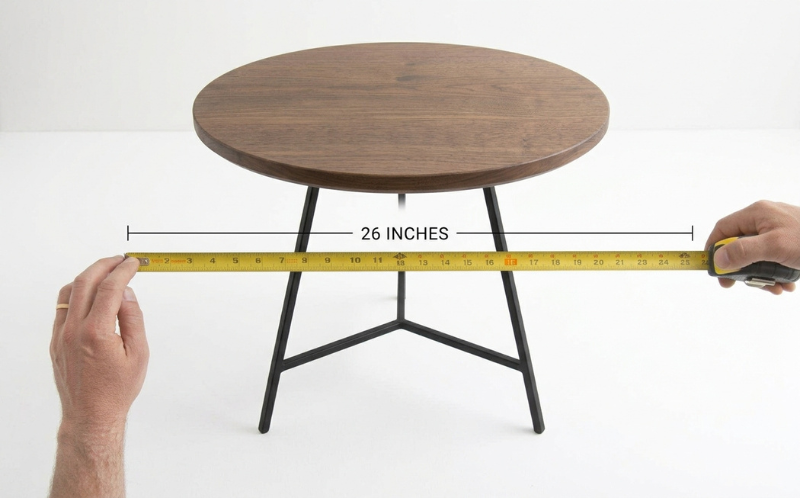
A small tabletop can have one dimension close to 26 inches.
For example, a square tabletop might measure approximately 26 inches by 26 inches.
That creates a reasonably compact surface for different purposes.
A tabletop of this general size could work for:
- A side table
- A craft table
- A small workstation
- A bedside table
- A plant stand
- A children’s activity table
How does it look in a room?
A 26-inch tabletop is a little over two feet across.
It is large enough to provide useful surface area without feeling like a full-sized dining table.
A rectangular table may also have one dimension of 26 inches. For instance, a table could be 26 inches deep and 40 inches wide.
That’s why it is important to check length, width, and height when comparing furniture.
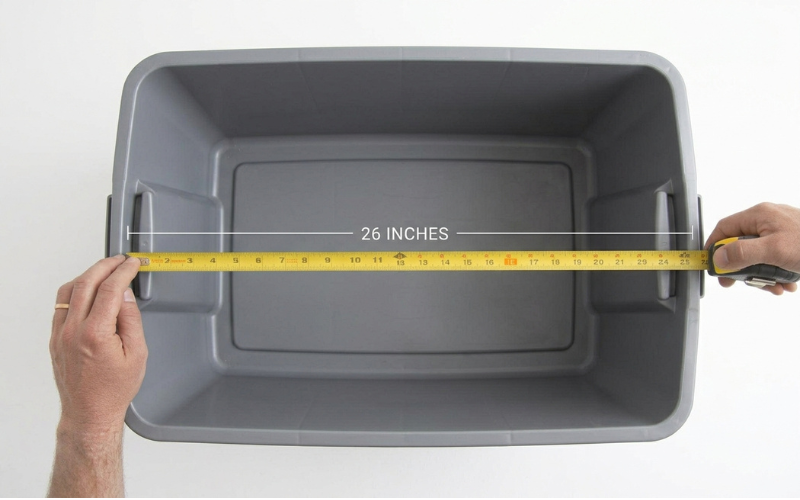
4. Large Storage Bin 📦
A large storage bin can have a longest side of around 26 inches.
Storage containers are used throughout homes, garages, offices, bedrooms, and closets. Their dimensions vary widely, but larger bins can easily reach this general length.
A container of this size may be useful for storing:
- Clothes
- Toys
- Books
- Shoes
- Tools
- Craft materials
- Holiday decorations
- Household supplies
Why storage bins are good visual references
Most large storage bins have straight sides.
That makes the longest dimension easy to identify.
Imagine a container that is 24 inches long. Adding 2 inches brings it to 26 inches.
The difference is not dramatic, but it is enough to notice when comparing two objects side by side.
Check the interior size
A storage bin’s advertised dimensions usually refer to its exterior measurements.
The usable space inside can be smaller because of the thickness of the walls and the shape of the container.
If you need it for a specific item, check the interior dimensions whenever they are available.
5. Large Serving Tray 🍽️
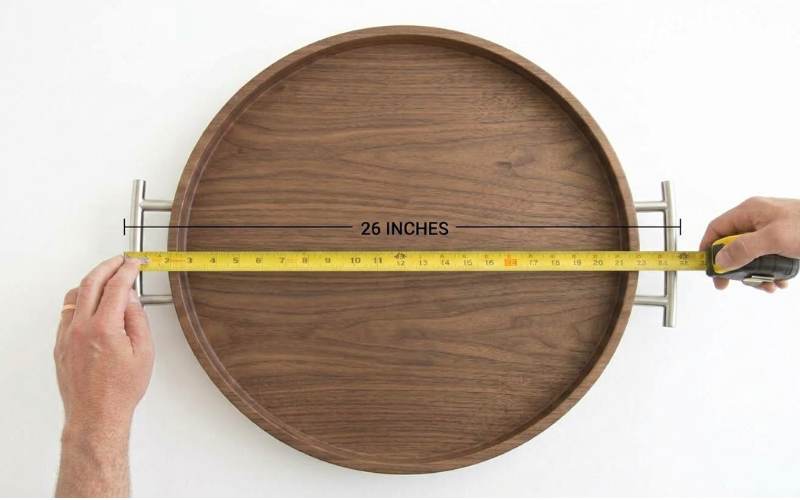
A large serving tray can also be close to 26 inches along its longest side.
These trays are designed for carrying meals, drinks, appetizers, desserts, dishes, and other items.
A rectangular tray is particularly easy to compare with this measurement because its longest edge provides a clear reference.
How much space does it take up?
A tray measuring around 26 inches stretches a little more than 2 feet across a counter or table.
That is considerably larger than many small serving trays.
It may therefore require a spacious cabinet, pantry shelf, or storage area.
Remember the handles
Some serving trays include handles that extend beyond the main tray.
If you are measuring the space needed to store one, measure from the outermost point on one side to the outermost point on the other.
The listed serving area may be smaller than the total outside length.
6. Large Cushion or Decorative Pillow 🛋️
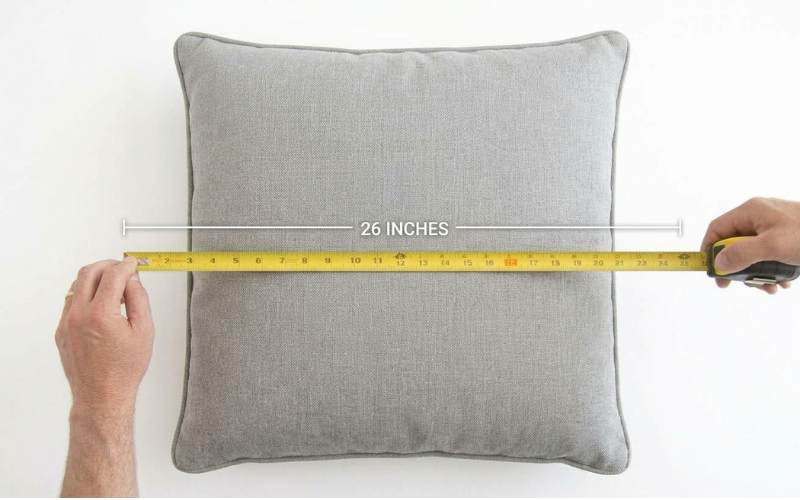
Large cushions can sometimes measure around 26 inches across.
Square cushions are particularly easy to visualize because their width and height can be identical.
A cushion measuring 26 inches by 26 inches would be slightly larger than two feet on each side.
Where might you find one?
Large cushions are commonly used on:
- Sofas
- Lounge chairs
- Outdoor furniture
- Window seats
- Beds
- Floor seating
Their soft material makes them comfortable, but it also means they can compress when pressure is applied.
Measuring a cushion correctly
Place it flat without pressing it down.
Measure from one edge to the opposite edge.
For a more reliable result, follow the manufacturer’s dimensions if the cushion has a specified size.
7. Large Desk Mat 🖥️
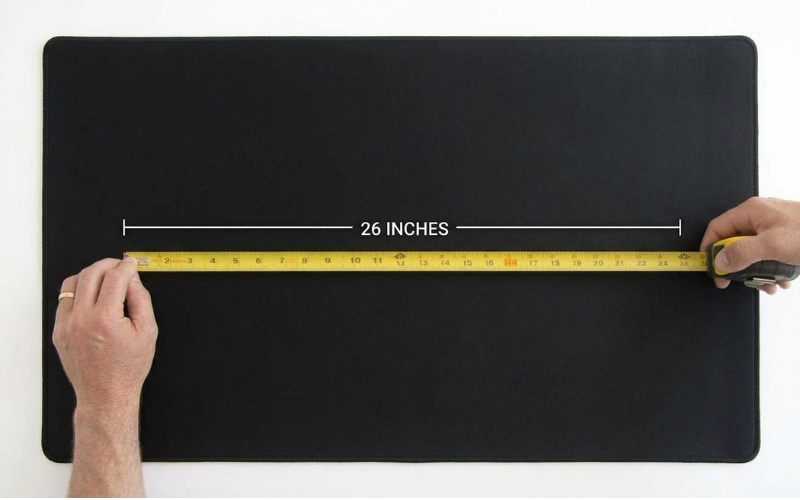
A large desk mat can have one dimension close to 26 inches.
These mats are popular for workstations and gaming setups. They provide a surface for keyboards, mice, notebooks, phones, and other desk accessories.
A larger mat can cover a substantial portion of a desk.
Why a desk mat is easy to visualize
Most desk mats have straight edges.
If one side measures about 26 inches, you can think of it as slightly more than two feet.
For example, a desk that is 52 inches wide could fit two 26-inch sections across its width.
That does not mean every 52-inch desk will accommodate two mats, of course. Depth and available clearance also matter.
Check the complete dimensions
Desk mats often come in measurements such as:
26 × 12 inches
or
26 × 16 inches
The first number does not tell you the entire size.
Check both dimensions before buying one for your workspace.
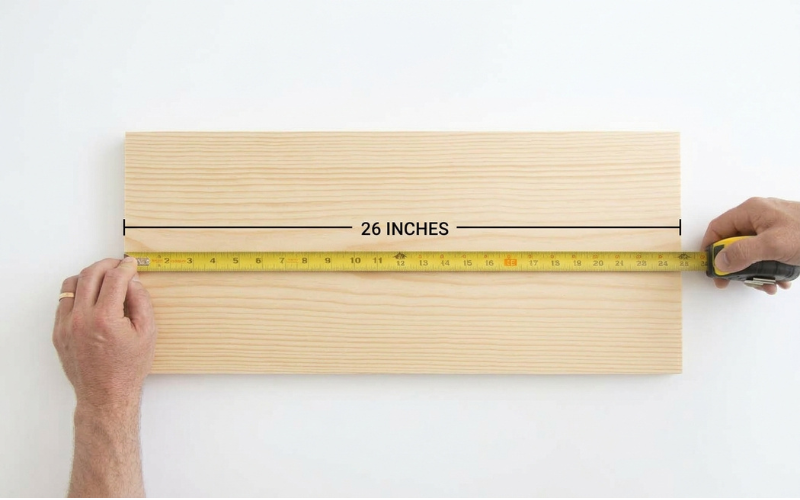
8. Wooden Board 🪵
A wooden board is one of the simplest physical examples of this length.
Unlike flexible materials, wood keeps its shape. A board can also be cut to a specific measurement.
A piece measuring 26 inches can be useful for:
- DIY shelving
- Crafts
- Furniture projects
- Small repairs
- Storage projects
- Wall decorations
- Garden projects
Why wood makes a great measurement reference
A straight board has two clear endpoints.
Measure from one end directly to the other, and you have the board’s length.
If it measures 26 inches, it is exactly 2 feet 2 inches.
For woodworking, precision matters. If a project calls for a specific measurement, use a tape measure rather than estimating from a familiar object.
How Long Is 26 Inches in Centimeters?
One inch equals exactly 2.54 centimeters.
To convert the measurement:
26 × 2.54 = 66.04 centimeters
Therefore:
26 inches = 66.04 cm
For everyday estimation, you can round that to approximately 66 centimeters.
This means the length is a little more than two-thirds of a meter.
How Long Is 26 Inches in Millimeters?
One inch equals 25.4 millimeters.
So:
26 × 25.4 = 660.4 millimeters
Therefore:
26 inches = 660.4 mm
This conversion is useful when reading technical specifications or detailed product measurements.
How Long Is 26 Inches in Meters?
To convert inches to meters:
26 × 0.0254 = 0.6604 meters
Therefore:
26 inches = 0.6604 meters
For a simple estimate, you can think of approximately 0.66 meters.
How Long Is 26 Inches in Feet?
There are 12 inches in one foot.
Divide 26 by 12:
26 ÷ 12 = 2.1667 feet
In the more familiar feet-and-inches format:
26 inches = 2 feet 2 inches
This is probably the easiest imperial measurement to remember.
Is 26 Inches More Than 2 Feet?
Yes. ✅
Two feet equals 24 inches.
The difference is:
26 − 24 = 2 inches
Therefore, this measurement is exactly 2 inches longer than 2 feet.
That small comparison is useful when estimating the size of furniture, shelves, and other household items.
Is 26 Inches More Than Half a Meter?
Yes.
Half a meter equals 50 centimeters.
The measurement we’re discussing equals 66.04 centimeters.
So the difference is:
66.04 − 50 = 16.04 centimeters
It is therefore 16.04 centimeters longer than half a meter.
Is 26 Inches Close to 60 Centimeters?
Yes, although it is somewhat longer.
Twenty-six inches equals 66.04 centimeters.
That makes it about 6.04 centimeters longer than 60 centimeters.
For quick estimation, saying “about 66 centimeters” is more accurate.
How Long Is 26 Inches Compared With 25 Inches?
The difference is exactly 1 inch.
Since 1 inch equals 2.54 centimeters, the difference is:
2.54 centimeters
So an object measuring 26 inches is only slightly longer than one measuring 25 inches.
How Long Is 26 Inches Compared With 24 Inches?
Twenty-six inches is 2 inches longer than 24 inches.
Because 24 inches equals 2 feet, this means the measurement is simply:
2 feet + 2 inches
That makes the comparison easy to remember.
How Long Is 26 Inches Compared With 23 Inches?
The difference is:
26 − 23 = 3 inches
Three inches equals 7.62 centimeters.
Therefore, a 26-inch object is 7.62 centimeters longer than one measuring 23 inches.
How Long Is 26 Inches Compared With 22 Inches?
Twenty-six inches is 4 inches longer than 22 inches.
In centimeters:
4 × 2.54 = 10.16 cm
So the difference is 10.16 centimeters.
How Long Is 26 Inches Compared With 20 Inches?
The difference is 6 inches.
Six inches equals:
6 × 2.54 = 15.24 centimeters
Therefore, this length is 15.24 centimeters longer than 20 inches.
How Long Is 26 Inches Compared With 18 Inches?
Twenty-six inches is 8 inches longer than 18 inches.
That equals:
8 × 2.54 = 20.32 centimeters
So the difference is 20.32 centimeters.
How Long Is 26 Inches Compared With 16 Inches?
The difference is:
26 − 16 = 10 inches
Ten inches equals 25.4 centimeters.
Therefore, the two measurements differ by exactly 25.4 centimeters.
How Long Is 26 Inches Compared With 12 Inches?
Twelve inches equals one foot.
The difference is:
26 − 12 = 14 inches
So the measurement is 14 inches longer than one foot.
Another easy way to remember it is:
26 inches = 2 feet 2 inches.
Can You Measure 26 Inches Without a Ruler? 📏
You can make a rough estimate without a ruler, although you should use an actual measuring tool whenever precision matters.
Several simple references can help.
Use Two Feet Plus Two Inches
This is the easiest method.
One foot equals 12 inches.
Two feet equal 24 inches.
Add two more inches:
24 + 2 = 26 inches
So you can visualize the measurement as a little more than two feet.
Use Two 12-Inch Rulers
Place two standard 12-inch rulers end to end.
Together, they measure:
12 + 12 = 24 inches
Add two more inches.
That gives you 26 inches.
Think in Centimeters
The metric equivalent is 66.04 centimeters.
For everyday estimation, you can simply remember:
26 inches ≈ 66 centimeters
This can be helpful if you are more familiar with the metric system.
Compare With a Familiar Object
A shelf, cutting board, tabletop, storage container, serving tray, cushion, desk mat, or wooden board may give you a rough sense of the size.
However, remember that household products are manufactured in different dimensions.
The Easiest Way to Remember This Length 🧠
Three conversions are especially useful:
26 inches = 2 feet 2 inches
26 inches = 66.04 centimeters
26 inches = 0.6604 meters
For a quick mental estimate, remember about 66 centimeters.
If you normally use feet and inches, simply think:
two feet plus two inches.
That gives you a reliable mental reference without having to calculate anything.
Why Comparing Measurements With Objects Helps
Measurements can sometimes feel abstract.
You may know that a particular length equals 66.04 centimeters, but that number alone may not tell you how large an object will look.
A familiar object provides context.
This can be especially useful when:
- Shopping online 🛒
- Comparing furniture
- Planning storage
- Measuring a workspace
- Choosing kitchen equipment
- Building shelves
- Working on DIY projects
- Checking whether an item will fit
- Planning room layouts
The goal is to understand the approximate scale before reaching for a measuring tape.
A Simple 26-Inch Estimation Challenge
Want to improve your measurement skills?
Try this quick activity.
Choose five objects around your home.
Before measuring them, guess whether each one is:
- Shorter than 26 inches
- Close to 26 inches
- Longer than 26 inches
Write down your guesses.
Then measure each object.
You may discover that some objects are much closer to your estimate than others.
Doing this occasionally can help you become better at judging everyday lengths.
Why Objects May Not Be Exactly 26 Inches
The examples in this article are common objects that can be around 26 inches long.
They are not standardized at this exact size.
A shelf might be 24 inches long, while another could be 26 or 30 inches. A cutting board may have a similar range of sizes.
The same is true for tables, storage bins, trays, cushions, desk mats, and wooden boards.
Product dimensions can vary
Several factors can affect an object’s size:
- Manufacturer
- Product design
- Intended use
- Material
- Available space
- Product category
- Model or version
That’s why a visual comparison should be treated as an estimate.
Use a measuring tape when accuracy matters
If something needs to fit inside a cabinet, shelf, room, vehicle, or storage area, measure the space first.
Also consider clearance.
An object may technically be shorter than the available space but still be difficult to install or remove if there is no room around it.
Where You Might Encounter a 26-Inch Measurement
Around the Kitchen 🍳
Large cutting boards and serving trays may have a dimension close to this size.
In the Living Room 🛋️
Large cushions, shelves, and compact furniture pieces can have dimensions in this range.
In the Bedroom 🛏️
Large decorative cushions, shelves, storage containers, and furniture components may use similar measurements.
In the Office 💻
Desk mats, shelves, work surfaces, and other accessories can have a side around this length.
In Storage Areas 📦
Large plastic bins and containers may reach approximately 26 inches on their longest side.
During DIY Projects 🔨
Wooden boards can be cut to exactly 26 inches for shelves, furniture, crafts, and repairs.
26 Inches in Different Units
| Unit | Equivalent |
|---|---|
| Inches | 26 in |
| Feet | 2.1667 ft |
| Feet + inches | 2 ft 2 in |
| Centimeters | 66.04 cm |
| Millimeters | 660.4 mm |
| Meters | 0.6604 m |
| Yards | 0.7222 yd |
| Approximate centimeters | 66 cm |
| Difference from 25 inches | 1 inch |
| Difference from 24 inches | 2 inches |
| Difference from 23 inches | 3 inches |
| Difference from 22 inches | 4 inches |
| Difference from 21 inches | 5 inches |
| Difference from 20 inches | 6 inches |
| Difference from 18 inches | 8 inches |
| Difference from 16 inches | 10 inches |
| Difference from 15 inches | 11 inches |
| Difference from 12 inches | 14 inches |
| Difference from 10 inches | 16 inches |
26-Inch Comparison Chart
| Measurement | Difference from 26 inches |
|---|---|
| 8 inches | 18 inches shorter |
| 10 inches | 16 inches shorter |
| 12 inches | 14 inches shorter |
| 14 inches | 12 inches shorter |
| 15 inches | 11 inches shorter |
| 16 inches | 10 inches shorter |
| 17 inches | 9 inches shorter |
| 18 inches | 8 inches shorter |
| 19 inches | 7 inches shorter |
| 20 inches | 6 inches shorter |
| 21 inches | 5 inches shorter |
| 22 inches | 4 inches shorter |
| 23 inches | 3 inches shorter |
| 24 inches | 2 inches shorter |
| 25 inches | 1 inch shorter |
| 26 inches | Reference length |
| 30 inches | 4 inches longer |
| 36 inches | 10 inches longer |
| 48 inches | 22 inches longer |
Biowiki Table: 26-Inch Measurement at a Glance
| Measurement | Equivalent |
|---|---|
| Length | 26 inches |
| Feet | 2.1667 feet |
| Feet + inches | 2 feet 2 inches |
| Centimeters | 66.04 cm |
| Millimeters | 660.4 mm |
| Meters | 0.6604 m |
| Yards | 0.7222 yd |
| Approximate metric value | 66 cm |
| Difference from 25 inches | 1 inch |
| Difference from 24 inches | 2 inches |
| Difference from 23 inches | 3 inches |
| Difference from 22 inches | 4 inches |
| Difference from 21 inches | 5 inches |
| Difference from 20 inches | 6 inches |
| Difference from 19 inches | 7 inches |
| Difference from 18 inches | 8 inches |
| Difference from 16 inches | 10 inches |
| Difference from 15 inches | 11 inches |
| Difference from 12 inches | 14 inches |
| Half of the length | 13 inches |
| Double the length | 52 inches |
Frequently Asked Questions
How long is 26 inches?
26 inches is exactly 2 feet and 2 inches. It also equals 66.04 centimeters, 660.4 millimeters, or 0.6604 meters.
What common things are around 26 inches long?
Examples include large wall shelves, wide cutting boards, small tabletops, storage bins, serving trays, large cushions, desk mats, and wooden boards.
Is 26 inches more than 2 feet?
Yes. Two feet equals 24 inches, so this measurement is 2 inches longer than 2 feet.
How many centimeters are in 26 inches?
There are exactly 66.04 centimeters in 26 inches.
How many millimeters are in 26 inches?
Twenty-six inches equals 660.4 millimeters.
Final Thoughts
Knowing how long is 26 inches becomes much easier when you connect the measurement with familiar objects.
A large wall shelf, cutting board, small tabletop, storage bin, serving tray, cushion, desk mat, or wooden board can help you develop a practical sense of this length. 📏
The most useful conversions to remember are:
26 inches = 2 feet 2 inches
26 inches = 66.04 centimeters
26 inches = 660.4 millimeters
26 inches = 0.6604 meters
For a quick mental estimate, think of about 66 centimeters or a little more than two feet.
Keep in mind that the objects used for comparison can vary in size. If you are measuring for a furniture purchase, DIY project, storage space, or another situation where precision matters, always confirm the measurement with a ruler or tape measure.
More to Explore
8 Common Things That Are 25 Inches Long