If you have ever wondered “How long is 1 inch?”, you are not alone. An inch is a small measurement, but it can be surprisingly difficult to visualize when you do not have a ruler nearby. Fortunately, several everyday objects can help you estimate what 1 inch looks like in real life.
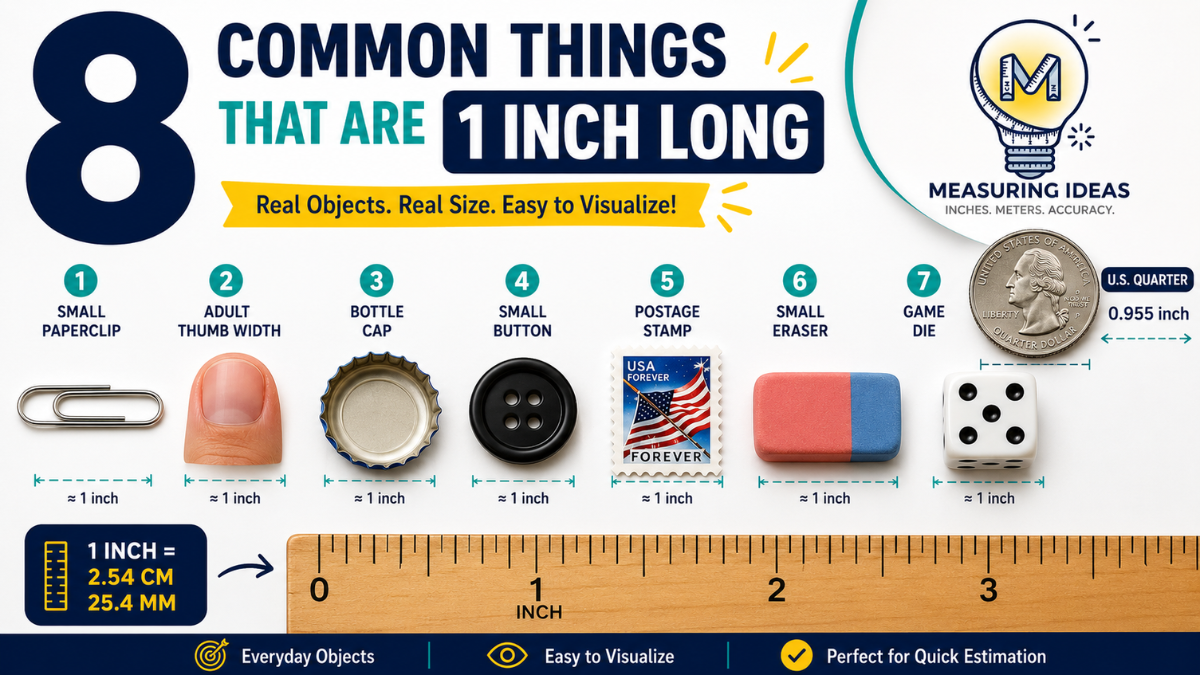
One inch equals exactly 2.54 centimeters or 25.4 millimeters. That may sound simple, but comparing it with familiar objects makes the measurement much easier to understand.
In this guide, we will look at 8 common things that are about 1 inch long or wide, along with practical ways to use them as quick references. Keep in mind that manufactured objects can vary slightly in size, so these examples are best for visual estimation rather than precision measuring.
Quick Answer: What Is 1 Inch?
1 inch = 2.54 centimeters = 25.4 millimeters
Here are eight everyday objects that can help you visualize approximately 1 inch:
| Common Object | Approximate 1-Inch Comparison |
| Small paperclip | About 1 inch long |
| U.S. quarter | 0.955 inches across |
| Adult thumb width | About 1 inch |
| Bottle cap | Around 1 inch across |
| Small button | About 1 inch across |
| Small postage stamp | Around 1 inch on one side |
| Small eraser | Around 1 inch wide |
| Standard game die | Close to 1 inch on some versions |
The important thing to remember is that not every example measures exactly 1 inch. They are useful because they are close enough to give you a quick mental reference. 📏
1. A Small Paperclip 📎
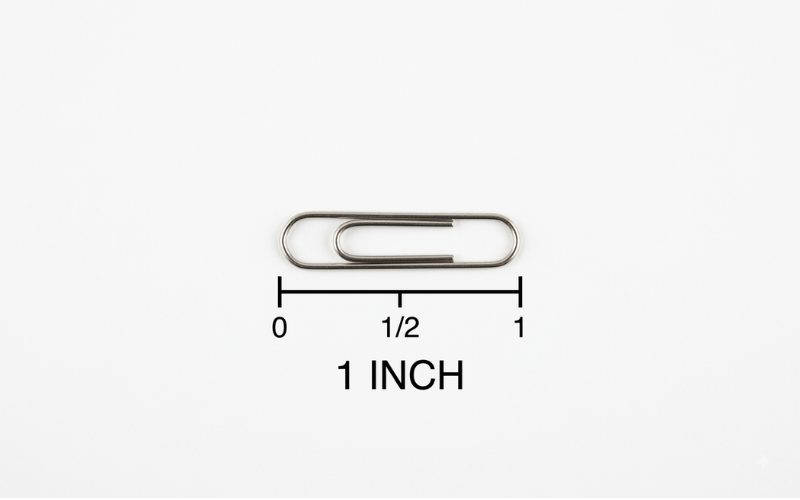
A small paperclip is one of the easiest objects to use when estimating 1 inch.
Paperclips come in many sizes, so you should choose a small or mini paperclip rather than the larger paperclips commonly used for thick stacks of paper. Some small paperclips measure approximately 1 inch from end to end.
The exact length depends on the manufacturer and design, but the basic shape makes it particularly convenient for visual comparisons.
Why a paperclip is useful
Paperclips are:
- Easy to find at home or work
- Straight enough to compare against a ruler
- Small enough to carry around
- Familiar to children and adults
- Useful for rough measurements
If you need to estimate whether something is close to an inch, placing it beside a small paperclip can give you a quick idea.
Important: A paperclip is only an approximation because there is no single universal paperclip size.
2. A U.S. Quarter 🪙
A U.S. quarter is another excellent reference for understanding a measurement close to 1 inch.
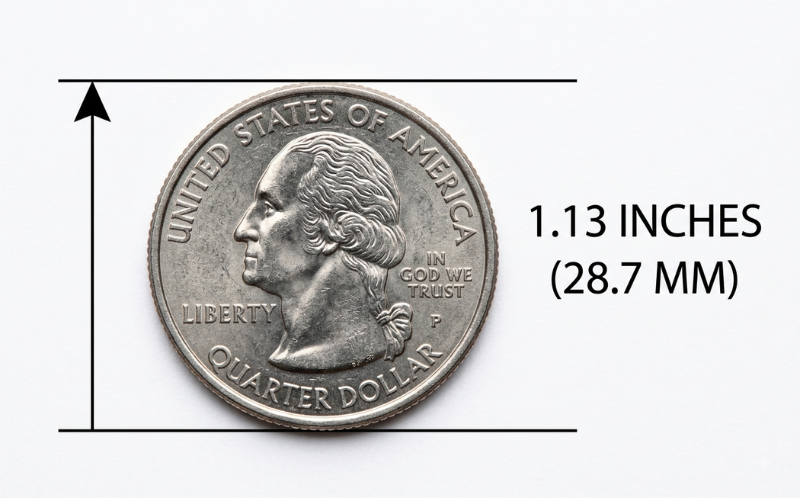
According to the U.S. Mint, a modern U.S. quarter has a diameter of 0.955 inches, or about 24.26 millimeters. That is only about 0.045 inches less than 1 inch.
That makes a quarter particularly useful when you need to visualize a measurement without a ruler.
How close is a quarter to 1 inch?
A quarter is:
- 0.955 inches in diameter
- Approximately 2.43 cm across
- Approximately 24.26 mm across
So, if you place a quarter next to a ruler, you will see that its width is just slightly less than one inch.
For quick everyday estimation, you can remember:
The diameter of a U.S. quarter is almost exactly 1 inch.
3. The Width of an Adult Thumb 👍
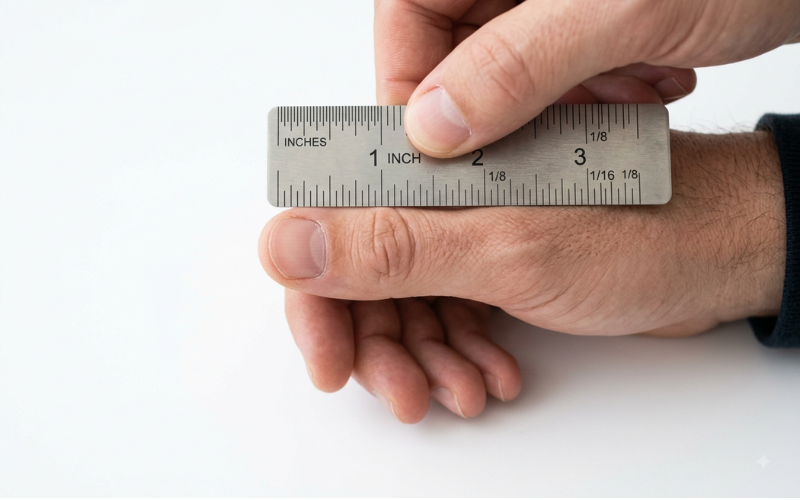
Your thumb can serve as a surprisingly useful built-in measuring reference.
For many adults, the width of the thumb near the tip or around the thumbnail area can be roughly close to 1 inch. However, this varies considerably from person to person.
That means your thumb should be treated as a personal approximation, not a standardized measurement.
Why your thumb can help
You always have it with you, which makes it useful for situations where you do not have a measuring tape or ruler.
For example, you might use your thumb to estimate:
- The width of a small gap
- The size of a small object
- The approximate spacing between two points
- A rough dimension for a craft project
If you frequently need to estimate measurements, you can measure your own thumb once with a ruler and remember its approximate width.
That gives you a personalized measuring tool you can use almost anywhere. 📏
4. A Bottle Cap 🧴
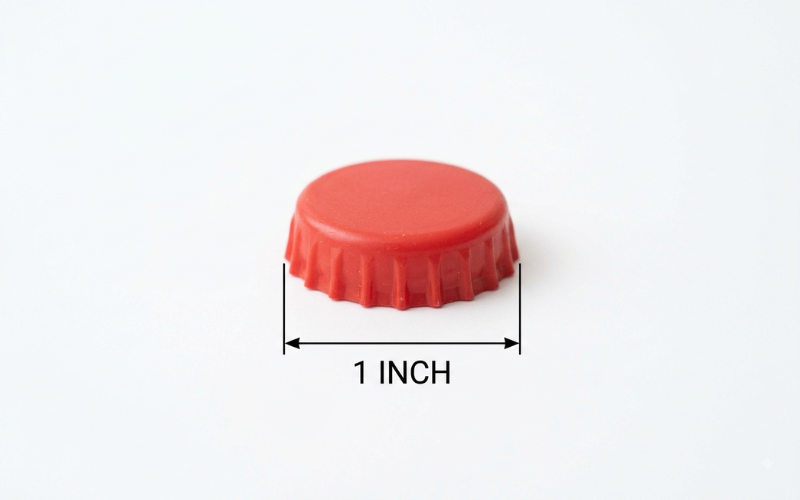
Some common bottle caps are close to 1 inch in diameter, making them another useful everyday comparison.
However, bottle caps come in many different sizes. A cap from a small bottle may be considerably smaller than a cap from a larger beverage container.
For that reason, a bottle cap should be considered an approximate 1-inch reference, rather than a guaranteed 1-inch object.
How to use a bottle cap as a reference
Place the bottle cap flat on a table and look at its widest point across the opening or exterior.
If its diameter is close to 1 inch, it gives you a handy visual representation of the measurement.
This is especially useful because bottle caps are commonly found in kitchens, garages, workshops, and recycling bins.
5. A Small Button 🔘
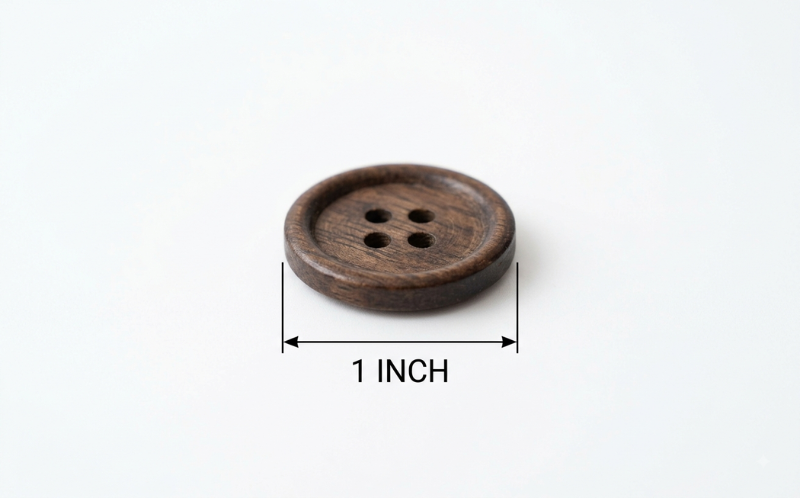
A small clothing or craft button can also be close to 1 inch across.
Buttons are manufactured in numerous sizes, so there is no universal button diameter. Still, many medium-sized buttons fall somewhere around the range that makes them useful for estimating a one-inch measurement.
If you have a button that measures about 1 inch from one edge to the opposite edge, it becomes a simple physical reference.
Where you might find one
You can find buttons on:
- Shirts
- Jackets
- Coats
- Sewing kits
- Craft supplies
- Children’s clothing
A button is particularly useful for crafts because it is already a small, round object that can be compared with other materials.
6. A Small Postage Stamp ✉️
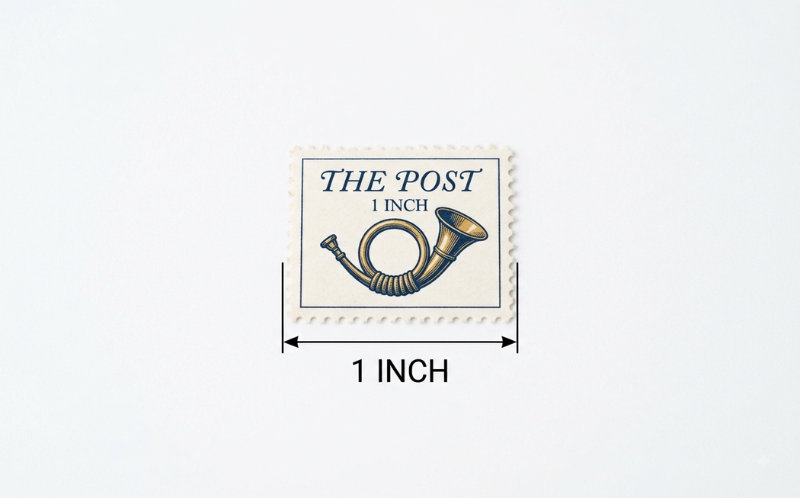
Some small or compact postage stamps can have a side measuring approximately 1 inch.
Stamp dimensions vary from country to country and even from one issue to another, so you should not assume every postage stamp is exactly 1 inch.
Still, a stamp with a side close to 1 inch can be useful when you need a quick visual comparison.
A useful stamp trick
If you have a stamp available, measure its shortest or longest side with a ruler once. After that, you will know whether it is a good personal reference for 1 inch.
This is a good example of how everyday objects can become useful measuring references even when they were never designed for measurement.
7. A Small Eraser ✏️
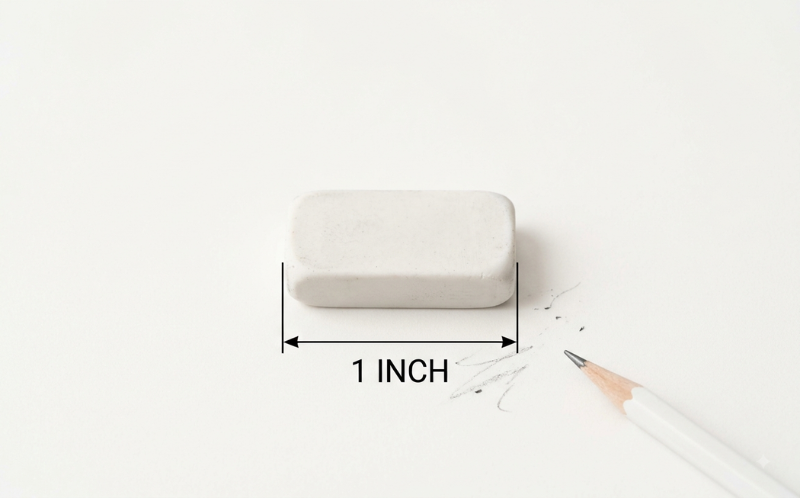
Small erasers are another familiar object that may come close to 1 inch in one dimension.
Pencil erasers are produced in many shapes and sizes. A small rectangular eraser may have a width or thickness close to one inch, although the actual measurement depends on the particular product.
An eraser is especially convenient as a reference for students because it is commonly found in pencil cases and on school desks.
Why it makes a good visual reference
An eraser is:
- Small
- Rectangular
- Easy to compare with a ruler
- Common in schools and offices
- Simple to place beside another object
If your eraser is approximately one inch wide, you can use it as a quick reference when estimating small dimensions.
8. A Standard-Sized Game Die 🎲
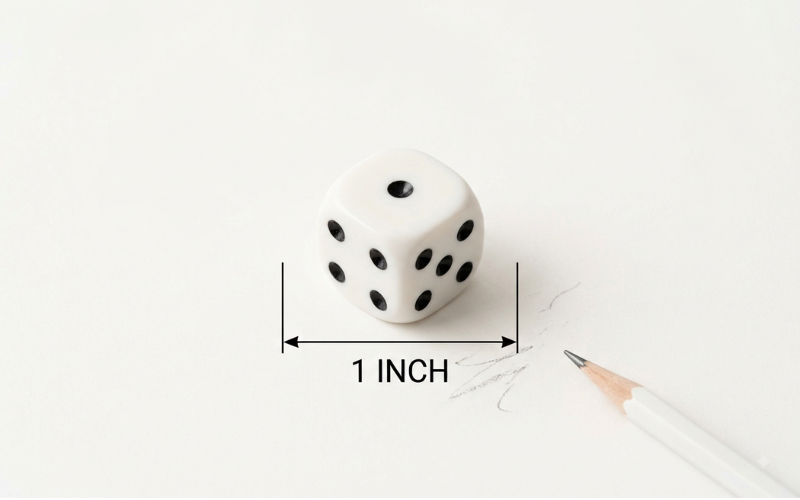
Some dice are close to 1 inch across, although this example requires an important qualification: dice are available in many sizes.
Many traditional board-game dice are smaller than 1 inch, while larger gaming or novelty dice can exceed 1 inch. Therefore, you should check the specific die before using it as a measuring reference.
A die that is close to 1 inch on each edge can nevertheless be a convenient way to understand the size of the measurement.
A fun way to remember 1 inch
Think of a small cube that is roughly an inch from one edge to the other.
Unlike a thin object such as a paperclip, a cube also gives you a sense of one inch in three dimensions.
How Long Is 1 Inch Compared With Other Measurements?
Understanding the conversions makes the size even easier to remember.
1 inch in centimeters
1 inch = 2.54 centimeters
So if you have a metric ruler, look for the 2.54 cm point.
1 inch in millimeters
1 inch = 25.4 millimeters
This is particularly useful for small objects because millimeters allow you to describe tiny differences more precisely.
1 inch in feet
1 inch = 1/12 of a foot, or approximately 0.0833 feet.
1 inch in meters
1 inch = 0.0254 meters.
These conversions are exact, unlike the everyday objects mentioned above, which are generally approximate references.
The Easiest Ways to Estimate 1 Inch Without a Ruler
What if you need to estimate an inch but do not have any of these objects nearby?
There are several simple methods you can try.
Use your thumb
Your thumb width may be close to an inch. Since everyone’s hands are different, measure your thumb once when you have access to a ruler.
After that, you will know how close your own thumb is to 1 inch.
Use a U.S. quarter
If you are in the United States and have a quarter available, its 0.955-inch diameter is remarkably close to an inch.
You can mentally treat the quarter as just slightly smaller than 1 inch.
Use a small paperclip
A small paperclip can provide a rough linear reference. Just remember that paperclips are manufactured in different sizes.
Make a personal reference
One of the most useful tricks is to choose one object you regularly carry or see and measure it accurately.
For example, you could measure:
- Your thumb
- A favorite pen
- A coin
- A small button
- A particular paperclip
Once you know its measurement, you can use it for future estimates.
Why Is 1 Inch Such a Useful Measurement? 📐
One inch may seem insignificant compared with larger measurements, but it appears frequently in everyday life.
Small measurements matter when:
- Measuring furniture hardware
- Working on crafts
- Checking product dimensions
- Sewing
- Building small projects
- Comparing electronics
- Measuring gaps
- Working with tools
- Understanding screen or component dimensions
A difference of even a fraction of an inch can matter when two pieces need to fit together.
That is why being able to recognize approximately one inch can be surprisingly practical.
1 Inch vs. 1 Centimeter: Is There a Big Difference?
Yes.
One inch equals 2.54 centimeters, meaning it is more than twice as long as 1 centimeter.
A simple comparison is:
1 inch = 2.54 cm
So if you are familiar with the size of a centimeter, imagine more than two centimeters placed end to end.
This distinction is important because people sometimes confuse inches and centimeters when looking at rulers that contain both measurement systems.
A Simple Memory Trick for 1 Inch 🧠
If you only remember one thing, remember this:
1 inch is about the width of a thumb and almost the diameter of a U.S. quarter.
The quarter is particularly useful because its official diameter is 0.955 inches, making it extremely close to one inch.
For a more precise conversion, remember:
1 inch = 2.54 cm = 25.4 mm
These three numbers are enough to convert one inch into several commonly used units.
Biowiki Table: 1-Inch Measurement at a Glance
| Measurement/Reference | Detail |
| Measurement | 1 inch |
| Symbol | in |
| Centimeters | 2.54 cm |
| Millimeters | 25.4 mm |
| Feet | 0.0833 ft |
| Meters | 0.0254 m |
| U.S. quarter diameter | 0.955 in |
| Approximate thumb width | Around 1 in, varies by person |
| Common visual references | Paperclip, bottle cap, button, eraser |
| Best precise tool | Ruler or measuring tape |
| Best everyday reference | U.S. quarter or measured thumb |
Things That Are Close to 1 Inch but Not Exactly 1 Inch
It is worth making one distinction clear: “about 1 inch” does not mean “exactly 1 inch.”
For example, a U.S. quarter is 0.955 inches across, not exactly 1 inch. The U.S. Mint lists the quarter’s diameter as 24.26 mm.
Similarly, paperclips, bottle caps, buttons, erasers, and dice can differ between manufacturers.
This is why everyday objects are excellent for estimating, but they should not replace a ruler when precision matters.
If you are cutting material, drilling holes, installing hardware, or doing detailed craft work, use an actual measuring instrument.
Frequently Asked Questions About 1 Inch
How long is 1 inch?
One inch is exactly 2.54 centimeters or 25.4 millimeters. It is a small unit of length commonly used for everyday measurements.
What object is exactly 1 inch long?
There is no single universal household object that is guaranteed to be exactly 1 inch long. Manufactured objects vary in size. A ruler or measuring tape is the best option for an exact measurement.
Is a quarter 1 inch?
A U.S. quarter is very close to 1 inch but is slightly smaller. Its official diameter is 0.955 inches, or about 24.26 mm.
Can I use my thumb to measure 1 inch?
You can use your thumb as a rough estimate, but thumb width varies from person to person. For better results, measure your own thumb with a ruler first.
How many centimeters are in 1 inch?
There are exactly 2.54 centimeters in 1 inch.
Final Thoughts
Knowing what 1 inch looks like can make everyday measurements much easier. You do not always need a ruler immediately when you only need a rough estimate.
A small paperclip, U.S. quarter, thumb width, bottle cap, small button, postage stamp, eraser, or appropriately sized die can help you develop a mental picture of this tiny measurement. 📏
For the most reliable reference, remember that 1 inch equals exactly 2.54 centimeters and 25.4 millimeters. And when accuracy really matters, always switch from an everyday comparison to a proper ruler or measuring tape.
Once you become familiar with the size of an inch, many small measurements become much easier to judge at a glance.